This article compares UK, US and German guidance. General information, not legal advice (status: November 2026).
In short
- There is no single legal office temperature. In the UK, the Approved Code of Practice suggests at least 16 °C for indoor work [1]. In the US, OSHA has no office temperature regulation but recommends 68–76 °F (20–24 °C) and 20–60% humidity [2]. Germany’s workplace rule ASR A3.5 sets at least 20 °C for seated office work and treats 26 °C as the upper target value [3].
- The same air temperature feels very different to different people. Thermal comfort depends on six factors: air temperature, radiant temperature, air movement, humidity, clothing and work rate [4].
- Standard comfort calculations use the metabolic rate of an average man and may overestimate women’s metabolic rate by up to 35% [5]. That is one reason why “too cold” is the most common office complaint in winter.
- Where you measure matters: a thermostat by the door says little about a desk next to a cold window.
- Room temperature data over the day and over weeks shows whether complaints reflect real deviations, cold surfaces or draughts.
The symptom: one thermostat, two complaints
Temperature is one of the most frequent topics in facilities helpdesks. A person by the window is freezing, two desks away a colleague is too warm. The facilities team checks the thermostat, sees 21.5 °C (71 °F) and closes the ticket. The next day the same complaints return, together with a fan heater under a desk.
For facilities managers and employers this is not only about comfort. Every degree on the set point costs heating energy, and raising the set point for one cold corner heats the whole building.
What the rules say
| Country | Rule or guidance | Minimum | Upper value |
|---|---|---|---|
| United Kingdom | Workplace Regulations with Approved Code of Practice | Normally at least 16 °C; 13 °C where work involves rigorous physical effort [1] | No legal maximum |
| United States | OSHA recommendation, no specific regulation | 68 °F (20 °C) recommended | 76 °F (24 °C) recommended [2] |
| Germany | Workplace rule ASR A3.5 | 20 °C for light seated work [3] | 26 °C target; above 30 °C measures are mandatory [3] |
Table 1: Office temperature rules and guidance compared. Status November 2026.
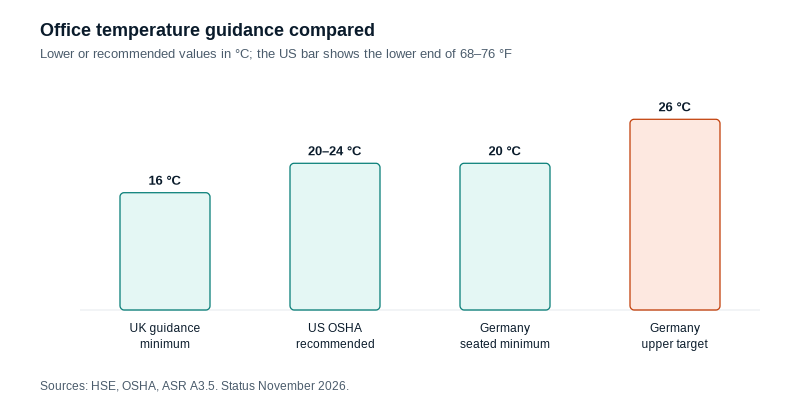
Figure 1: Office temperature guidance in the UK, the US and Germany. Sources: [1][2][3].
The UK figures are guidance that accompanies a legal duty to keep indoor temperatures reasonable; employers still have to assess their own workplace [1]. The German rule also specifies where to measure: at 0.6 m height for seated work, with a radiation-shielded thermometer [3].
Why 21 °C is not the same for everyone
HSE describes thermal comfort as the result of six factors [4]:
- Air temperature: what the thermometer shows.
- Radiant temperature: the body exchanges heat with all surfaces around it. A large cold window or external wall draws heat away even when the air is warm.
- Air movement: draughts from windows, doors or supply air diffusers cool the body.
- Humidity: mainly noticeable at higher temperatures.
- Clothing: a jumper or jacket shifts comfort by several degrees.
- Work rate: sitting produces less body heat than standing or walking.
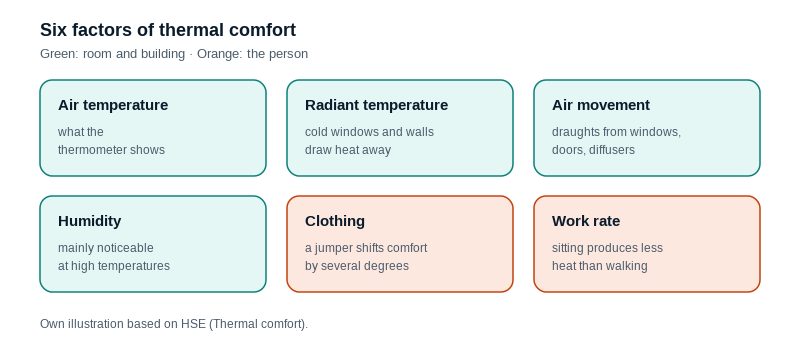
Figure 2: The six factors of thermal comfort. Own illustration based on [4].
On top of that come individual differences. A widely cited analysis in Nature Climate Change showed that standard metabolic values in comfort models are based on an average male and may overestimate female metabolic rates by up to 35% [5]. People who produce less heat feel the same room as cooler; the authors argue that using actual metabolic rates would also make energy predictions more accurate [5].
Common mistakes
- Measuring in the wrong place: at the thermostat by the door instead of at the window desks.
- Looking only at air temperature: cold glass and draughts stay invisible.
- Raising the set point for everyone: heats the whole building for one cold zone and makes other zones too warm.
- Tolerating fan heaters: they mask the cause and add electricity use and fire risk.
- Ignoring summer: in many offices overheating, not cold, is the bigger problem.
What to do about it
| Cause | Measure |
|---|---|
| Cold windows and external walls | Move desks away from glazing, keep radiators under windows free, improve glazing in the long term |
| Draughts | Rebalance supply air diffusers, check window and door seals |
| Uneven heating | Check hydronic balancing and room controls |
| Individual differences | Zones with different set points, let people choose seats by preference, relaxed dress codes |
| Summer overheating | Solar shading, night cooling, reduce internal gains |
Table 2: Causes of temperature complaints and typical measures.
For rooms that heat unevenly, see hydronic balancing in commercial buildings.
How Nebatic helps
Nebatic measures temperature, humidity and CO₂ continuously, room by room. The histories show which rooms are still cold when people arrive, where summer temperatures regularly exceed comfortable levels and whether complaints match real deviations. Measures can then target single zones instead of the whole building. See monitoring summer overheating and having indoor air quality measured.
Nebatic does not replace a workplace risk assessment. The data supports the people responsible for it.
Risks and limits
- Responsibility: workplace risk assessments belong to the employer and their safety advisers.
- Perception stays individual: even within all guidance values, some people will be uncomfortable. Data helps to discuss complaints objectively.
- Energy: each degree of extra heating costs energy; a German rule of thumb puts it at about 6% of heating energy per degree [6].
Further reading: indoor air quality in offices.
Office temperature: quick answers
What is the legal minimum office temperature in the UK?
The Approved Code of Practice suggests at least 16 °C for indoor work, or 13 °C where work involves rigorous physical effort [1]. These are guidance figures that accompany the duty to keep temperatures reasonable.
What temperature should an office be?
OSHA recommends 68–76 °F (20–24 °C) [2]; the German workplace rule sets at least 20 °C for seated work and 26 °C as the upper target [3]. Comfort also depends on surfaces, draughts and clothing.
Is there a maximum office temperature?
Not in UK law [1]. In Germany, employers should act above 26 °C and must act above 30 °C [3].
Why are women often colder in the office?
Comfort models use the metabolic rate of an average man, which may overestimate women’s metabolic rate by up to 35% [5]. Lower heat production means the same room feels cooler.
How do I solve constant temperature complaints?
Measure first: where and when is it too cold or too warm? Then act locally on cold windows, draughts, heating balance or zone set points instead of raising the temperature everywhere.
Sources
- Health and Safety Executive (HSE): Temperature in the workplace – what the law says. https://hse.gov.uk/temperature/employer/the-law.htm
- OSHA Standard Interpretation, 24 Feb 2003: Reiteration of existing OSHA policy on indoor air quality: office temperature/humidity and environmental tobacco smoke. https://www.osha.gov/laws-regs/standardinterpretations/2003-02-24
- FORUM Verlag: ASR A3.5 room temperature in the office (German). https://www.forum-verlag.com/fachwissen/arbeitsschutz/asr-a3-5-raumtemperatur-im-buero/
- Health and Safety Executive (HSE): Thermal comfort. https://www.hse.gov.uk/Temperature/Thermal/
- Kingma, B., van Marken Lichtenbelt, W. (2015): Energy consumption in buildings and female thermal demand. Nature Climate Change 5. https://cris.maastrichtuniversity.nl/en/publications/energy-consumption-in-buildings-and-female-thermal-demand
- co2online: Heating myths (German). https://www.co2online.de/energie-sparen/heizenergie-sparen/heizkosten-sparen/heizmythen