This article covers EU rules that apply in all member states through national law, and uses Germany as an example market for national rules and figures. Legal references are general information, not legal advice (status: October 2026).
Key points
- White-label energy monitoring lets a service provider sell continuous monitoring of a building’s energy use and indoor climate under its own brand, on a technology partner’s devices and platform. For facility management (FM) companies, energy consultants, installers and integrators, it adds a recurring service to one-off work such as audits or commissioning.
- Calculated demand and measured consumption are often far apart. In German homes, measured heating energy use was on average about 30% below the calculated value [1]; for non-residential buildings, a review for the German Environment Agency gives 13 to 31% [2]. Only operating data shows where a building really stands.
- Ongoing data is gaining value through EU building automation rules for non-residential buildings above 70 kW [21], energy management and audit duties [20], sustainability reporting [9] and a shortage of skilled trades [10].
- There are five common service models: one-off measurement, monitoring subscription, white label, measurement and verification (M&V) in energy performance contracting, and data-driven energy consulting. They differ in effort, contract length and responsibility.
- Offering monitoring takes hardware, a platform, clean data, a fixed process and clear roles; data protection, responsibilities and liability must be settled up front.
What monitoring as a service means
A provider measures a building’s energy use and indoor climate continuously, analyses the data and gives the client regular findings and reports; the client needs no platform or in-house analysts. This is often called monitoring as a service; sold under the provider’s own name on a partner’s technology, it is white-label monitoring.
The business case starts with a gap in today’s services. An energy consultant calculates demand and writes recommendations, an installer commissions a system, a facility manager checks on a walk-round that everything runs. All three are technically sound, and all three are snapshots. What happens afterwards in operation usually goes unseen.
Why one-off visits miss real operation: the performance gap
The difference between calculated demand and measured consumption is known as the “performance gap”, and it is well documented for Germany.
Residential buildings: in 2012, Sunikka-Blank and Galvin (University of Cambridge) compared energy ratings with measured consumption in about 3,400 German homes. The calculated rating averaged about 225 kWh/m²a, measured heating energy use about 150 kWh/m²a, around 30% less [1]. For buildings with high calculated demand (300 kWh/m²a), consumption was about 40% lower; at 150 kWh/m²a, about 17% [1]. The authors call this the “prebound effect” and attribute it mainly to occupant behaviour, such as lower room temperatures, but they also point to possible weaknesses in the calculation assumptions [1].
Non-residential buildings: an ad hoc paper for the German Environment Agency (von Manteuffel and Offermann, Guidehouse, 2022, updated 2023) summarises the research. For non-residential buildings it cites a 2017 evaluation by the Federal Institute for Research on Building, Urban Affairs and Spatial Development (BBSR): consumption was on average 13 to 31% below calculated demand, with larger deviations where demand was high [2]. For very efficient buildings below about 50 kWh/m²a, the relationship can reverse, with consumption above demand [2].
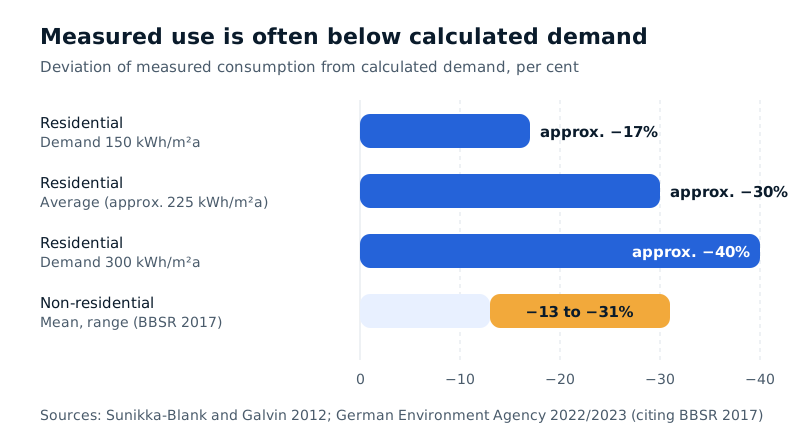
Figure 1: Measured consumption compared with calculated demand. Sources: Sunikka-Blank and Galvin 2012 [1]; German Environment Agency 2022/2023, citing BBSR 2017 [2].
This has two consequences for service businesses. First, savings derived from calculated demand alone can be badly wrong. The Environment Agency paper works through an example from a study by Loga et al. (2019): if the calculated demand of a partly renovated building is halved from 250 to 125 kWh/m²a, the expected measured saving is only about 60% of the calculated value [2]. Second, demand says nothing about whether the systems run today as designed.
US research shows how much is lost in operation. In 2011, Evan Mills (Lawrence Berkeley National Laboratory) analysed data from 643 non-residential buildings that had undergone retro-commissioning. The median saving in total energy use was 16%, with a payback of 1.1 years [3]. The figures do not transfer directly to Europe, but they show that faults in controls and operation are common and some are cheap to fix.
Causes: what happens between design and operation
Operation drifts from the design for four reasons.
1. The calculation assumes standard values. Standard calculations, such as the German DIN V 18599, use fixed assumptions for room temperature, operating hours, number of occupants and ventilation. The real building is used differently: an office is half empty on Fridays, a school has holidays, a shop heats its entrance area harder. The Environment Agency paper shows that more realistic assumptions alone can cut the calculated demand of an example building by 14 to 39% [2].
2. Systems change. Sensors drift, valves stick, a schedule is not reset after a fault, a setpoint raised “temporarily” stays raised. An annual service may miss such faults because they occur only at night, at weekends or in the shoulder seasons.
3. Nobody has the overview. Meter readings sit with the utility, fault messages in the building management system, complaints about stuffy air with the caretaker. Unconnected, they show no pattern.
4. Indoor climate and energy are linked. Less ventilation lowers energy use, but air quality suffers. The indoor air hygiene commission of the German Environment Agency rates CO₂ levels below 1,000 ppm as hygienically harmless, 1,000 to 2,000 ppm as hygienically conspicuous and above 2,000 ppm as hygienically unacceptable [16]. Looking only at energy can produce a “saving” at the occupants’ expense.
A one-off visit sees only part of this. Continuous monitoring shows patterns: night-time use, weekday versus weekend, indoor climate at peak times.
Consequences and common mistakes
For owners, the gap means uncertainty: renovations are planned on calculated values whose effect is never checked. For providers it is a reputational risk: if a recommended measure misses the promised saving, it reflects on the consultant, even when the cause lies in operation.
Typical mistakes when starting a monitoring service:
- Data without a mandate: sensors are installed, but nobody is responsible for looking at the data regularly. The result is a data graveyard.
- Too many data points, too few questions: everything is measured instead of starting with a clear question (“Why is heat use so high at weekends?”).
- No baseline: without a reference period, no saving can be proven.
- Unclear responsibility: the monitoring provider spots a fault, but it is the maintenance contractor or the operator, not the provider, who may change the plant. If the route is not agreed, the alert goes nowhere.
- Data protection considered too late: room data can allow conclusions about individuals (see “Limits and risks”).
Market drivers: why recurring monitoring services are in demand
EU: continuous monitoring in building automation (EPBD)
The recast Energy Performance of Buildings Directive, Directive (EU) 2024/1275, requires non-residential buildings with heating, air-conditioning or combined ventilation systems above 290 kW (by the end of 2024) and above 70 kW (by 31 December 2029) to have building automation and control systems, where technically and economically feasible. These systems must continuously monitor, log and analyse energy use, benchmark efficiency, detect efficiency losses, inform the people responsible about possible improvements and, by 29 May 2026, be able to monitor indoor environmental quality [21]. The duty falls on owners; who then reads the data and passes findings to the operator is left open. That is where demand for services arises.
EU: energy management and audits for larger companies (EED)
The recast Energy Efficiency Directive, Directive (EU) 2023/1791, requires enterprises with average annual energy consumption above 85 TJ over the previous three years to implement a certified energy management system by 11 October 2027. Enterprises above 10 TJ that do not have one must carry out an energy audit, the first by 11 October 2026 and then at least every four years [20]. Energy management systems are often based on EN ISO 50001 [17]. Both rely on reliable measured data.
Sustainability reporting: a smaller circle, the same data needs
With the Omnibus I package, the EU has narrowed the scope of the Corporate Sustainability Reporting Directive (CSRD). The Council gave final approval on 24 February 2026; in essence, companies with more than 1,000 employees and more than €450 million net turnover must report [9]. Member States have one year to transpose the change [9]. Fewer clients are directly affected than originally planned, but those in scope, and suppliers to them, still need traceable consumption data instead of estimates.
Skills shortage: remote analysis instead of call-outs
For Germany, the Competence Centre for Securing Skilled Labour (KOFA) at the German Economic Institute estimates that in 2025, almost 100,000 vacancies in skilled craft occupations could not be filled. In building electrics, more than seven in ten vacancies stayed open, and plumbing, heating and air-conditioning is also among the top shortage occupations [10]. Remote data lets scarce technicians plan site visits and go first where a problem is likely.
Example market Germany: GModG, EnEfG and funded energy advice
Since 29 July 2026 the former Buildings Energy Act has been called the Building Modernisation Act (Gebäudemodernisierungsgesetz, GModG); the amending act of 23 July 2026 was promulgated on 28 July 2026 (BGBl. 2026 I No. 226), and some parts apply from 1 January 2027 [6]. § 56 GModG requires non-residential buildings with heating, air-conditioning or combined ventilation systems above 70 kW rated output (previously 290 kW) to have building automation and control, where technically possible and economically reasonable, essentially by 31 December 2029 [5][6]. Its required functions largely follow the EU list, including a common, freely configurable data interface [5].
The German Energy Efficiency Act (Energieeffizienzgesetz, EnEfG) requires companies using more than 7.5 GWh of final energy a year on average to set up an energy or environmental management system that records energy inputs and outputs [7]. Companies above 2.5 GWh must also draw up and publish concrete implementation plans for economic savings measures, with economic viability assessed according to DIN EN 17463 [8]. The federal funding programme for energy advice for non-residential buildings, run by the Federal Office for Economic Affairs and Export Control (BAFA), has three modules: an energy audit to DIN EN 16247, energy advice to DIN V 18599 and orientation advice on contracting [11]. Operating data can complement all three. Funding questions go to BAFA or an approved energy consultant.
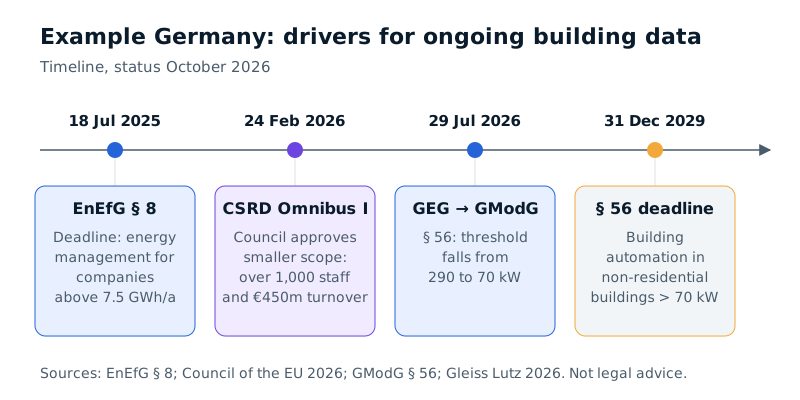
Figure 2: Legal drivers for ongoing building data in Germany at a glance (status: October 2026). Sources: EnEfG § 8 [7]; Council of the EU 2026 [9]; GModG § 56 [5]; Gleiss Lutz 2026 [6].
White-label energy monitoring and other service models compared
Monitoring as a service is a family of offers rather than one product. Five models are common, and they can be combined, for example a one-off measurement as an entry point and a subscription to follow.
| Model | What the client gets | Duration | Provider effort | Typical providers |
|---|---|---|---|---|
| One-off measurement | Measurement campaign over an agreed period, with report and recommendations | Weeks to months | Planning, installation, analysis, report | Energy consultants, surveyors, installers |
| Monitoring subscription | Continuous data capture, regular analysis, alerts on anomalies | Ongoing, usually with a minimum term | Platform operation, regular review, client contact | Facility management, energy service companies |
| White label | Monitoring under the provider’s brand, technology and platform from a partner | Ongoing | Sales, account management, expert analysis; technology with the platform partner | Energy consultants, installers, FM firms without in-house software development |
| M&V in energy performance contracting | Proof of the contractually guaranteed saving against a baseline | Contract term, typically 7 to 12 years [12] | Baseline, adjustment (e.g. for weather), annual savings report | Contractors (ESCOs), appointed experts |
| Data-driven energy consulting | Advice that combines operating data with the demand calculation | Project, possibly with a follow-up check | Data preparation, demand vs consumption comparison, recommendations | Energy consultants |
Table 1: Service models for building monitoring (own illustration).
One-off measurement
The easiest entry point, typically before a refurbishment, when looking for the cause of mould or high heating costs, or for a before-and-after comparison. Clear scope, clear price, no ongoing operation; but the result only covers the measurement period, and a summer measurement misses the heating season.
Monitoring subscription: a remote building monitoring service
With a subscription, the equipment stays in the building and the provider reviews data, reports anomalies and proposes measures: a remote building monitoring service. A study by Lawrence Berkeley National Laboratory (Kramer et al., 2019), using data from the US Smart Energy Analytics Campaign, shows what operators achieved with energy management information systems: those reporting savings achieved a median of 7% a year, and the savings grew over time [4]. Cost data from 35 portfolio owners also shows an important pattern: median estimated annual staff costs were higher than annual software costs [4]. Monitoring is mainly a people service, not just a software licence. These are US data from campaign participants, so transferability is limited.
White-label building monitoring
In white-label building monitoring, a service provider offers monitoring under its own name but uses a technology partner’s devices and platform. For energy consultants and smaller installation firms, this is often the realistic route: developing and running a platform ties up capacity that the core business needs. The provider brings the client relationship and expertise, the partner hardware, software, updates and data storage. The same model works for white-label indoor air quality monitoring, for example CO₂ monitoring in offices or schools. What matters is a clear agreement on who answers to the end client for what.
Measurement and verification in energy performance contracting
In energy performance contracting, a contractor (often an energy service company, ESCO) plans, finances and implements efficiency measures and guarantees a saving. According to the German Energy Agency (dena), contracts usually run for 7 to 12 years, energy controlling and management can be part of the services, and the contractor bears the difference if the agreed saving is missed [12]. The basis is a baseline from a reference period; the saving is proven annually and adjusted for non-contractual influences such as weather [13]. So measurement and verification for energy performance contracting is not an add-on but the core of the billing.
Internationally, the International Performance Measurement and Verification Protocol (IPMVP) is a common reference for M&V. The US Department of Energy’s Federal Energy Management Program, for example, publishes M&V guidelines for performance-based contracts such as energy savings performance contracts, whose procedures are intended to be fully compatible and consistent with the IPMVP [19]. An energy dashboard for buildings can make this data visible to contractor and owner alike.
Data-driven energy consulting
Here the consultant adds measured load profiles, room temperatures, CO₂ trends and operating hours to the demand calculation, to test its assumptions and, later, the effect of measures. Good sub-metering and data logging for energy consultants has to do two things above all: it must install without much disruption to operation, and the data must be easy to turn into an advisory report. Anyone working with a technology partner should agree who supplies, sets up and replaces devices when they fail.
What clients get from a monitoring service
For owners and operators, the benefit comes down to five points:
- Transparency: consumption and indoor climate become visible, not just once a year through the bill.
- Early detection: anomalies such as night-time heating or persistently high CO₂ are caught before they cause lasting costs or complaints.
- Proof of effect: whether a measure works can be checked with data from before and after.
- A basis for compliance: data helps with building, energy efficiency or reporting rules, but does not replace an expert or legal assessment.
- One point of contact: the provider turns data into concrete actions instead of handing the client yet another dashboard.
For portfolios, energy monitoring across sites with consistent indicators shows which building stands out and where a closer look pays off.
What you need to offer monitoring
It takes more than sensors: five building blocks belong together.
| Building block | What it includes | Typical questions |
|---|---|---|
| Hardware | Room sensors (e.g. CO₂, temperature, humidity), meters or meter interfaces, network connection | Wireless or wired? Is Wi-Fi available? Who installs and replaces? |
| Platform | Data storage, display, analysis, reports, interfaces | Own brand possible? Export to CAFM or BI software? |
| Data | Data points, mapping to rooms and systems, reference period, weather data | What is the baseline? What data exists from current systems? |
| Process | Regular review, alert thresholds, route from alert to action, report | How often is data reviewed? Who informs whom? |
| Roles | Data analysis, account management, on-site technical work, data protection | Who may change the plant? Who is the controller under the GDPR? |
Table 2: Building blocks of a monitoring service (own illustration).
On hardware, start with what is there: many non-residential buildings have meters, a building management system or sensors whose data is simply not brought together. In Germany, § 56 GModG explicitly requires a common, freely configurable interface for the mandatory systems [5], and the EPBD requires interoperability across manufacturers [21]; both will make manufacturer-independent analysis easier. For classifying automation functions, EN ISO 52120-1 offers a common framework [18].
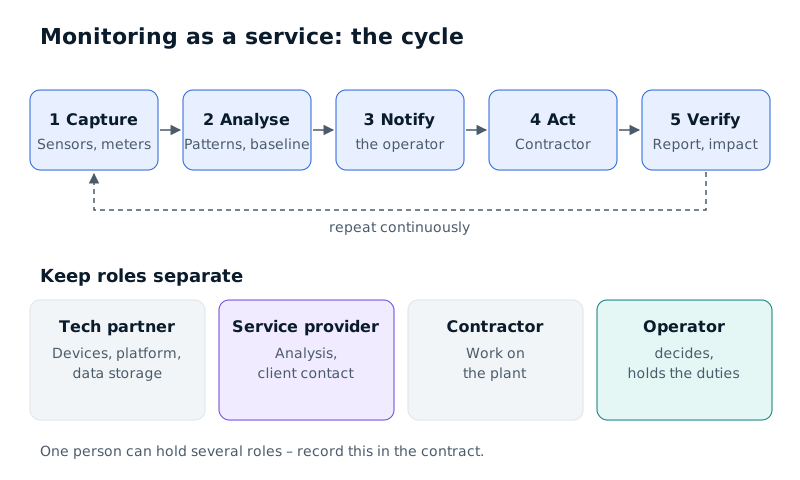
Figure 3: Process and roles of a monitoring service (own illustration).
Roles in digital facility management
In digital facility management, data analysis partly replaces walk-rounds and site visits become more targeted, but roles must stay clear. The monitoring provider reports, the contractor works on the plant, the operator decides; if one person holds several roles, the contract should say so.
Business model: how recurring monitoring pays
Prices depend on building size, number of data points, scope of analysis and contract length, so no general prices can responsibly be given. The structure of costs and revenue can be described.
Provider cost blocks:
- one-off: planning, hardware, installation, platform set-up, defining the baseline;
- ongoing: platform and data transfer, regular analysis, client communication, replacing faulty devices;
- occasional: site visits after alerts, reports, adjustments.
Revenue logic: one-off services are billed as projects, ongoing ones as a subscription or framework contract. Recurring revenue makes capacity planning easier but creates an ongoing obligation to deliver.
The LBNL study cited above shows how the cost blocks relate: median installation costs were US$0.03 per square foot, annual software costs US$0.02 and estimated annual staff costs US$0.03 per square foot [4]. The absolute values say little about European markets, but ongoing human work is clearly a major cost block. Price in the time for analysis and client contact, and design processes that use it efficiently across buildings.
Worked example (illustrative, own assumptions): a provider looks after 20 buildings on subscription and plans 1 hour per building per month for review and reporting, plus 2 site visits per building per year of 3 hours each. That gives 20 × 12 × 1 = 240 hours of analysis and 20 × 2 × 3 = 120 hours on site, 360 hours a year in total. The assumptions are freely chosen to show the structure, not empirical values. The key point: analysis time grows with the number of buildings, site time with the number of anomalies. Good thresholds and clear alerts reduce both.
How Nebatic helps
Nebatic offers service providers white-label monitoring: energy consultants, facility management companies and installation firms can offer their clients monitoring as a service under their own name. It is based on Nebatic devices, Nebatic Core (CO₂, particulate matter, VOC, temperature, humidity, light, sound) and Nebatic AirSense (CO₂, particulate matter, VOC, temperature, humidity), connected via Wi-Fi, and on a platform with live values, trends, anomalies, alerts and reports. Existing sensors, meters and systems can be connected, and data can flow through interfaces into CAFM, BI or ESG software.
Partners work with Nebatic as technology and service partners; see the partner programme. Nebatic does not install classic building automation; for that, it works with installers and system integrators.
Limits and risks
What monitoring does not do. Monitoring shows what happens in the building. It does not replace maintenance, safety-relevant alarm systems, energy advice, expert surveys or legal advice. A monitoring platform on its own is also not automatically a building automation and control system in the sense of the EPBD or § 56 GModG. Whether a solution meets the legal requirements has to be checked case by case with design engineers and, where needed, legal advisers.
Data protection. Room data such as CO₂, noise or motion are technical readings at first. If they can be linked to a specific person, for example in a single office, they can be personal data under Art. 4(1) of the General Data Protection Regulation (GDPR) [14]. The GDPR then applies. If the monitoring provider processes data on behalf of the building operator, a data processing agreement under Art. 28 GDPR is needed [14]. In Germany, where a company has a works council, it has a right of co-determination under § 87(1) no. 6 of the Works Constitution Act (BetrVG) when technical equipment designed to monitor employees’ behaviour or performance is introduced [15]. In practice it helps to record data at room level rather than person level, choose only the parameters needed, set retention periods and inform employees early. General information, not legal advice (status: October 2026).
Responsibilities. Seeing a problem does not mean being allowed to fix it. The contract should say who receives alerts, who decides and who works on the plant, with one reporting route for everyone.
Liability. Ongoing analysis means responsibility. Clarify whether you owe checks at fixed intervals or only data provision, the response times, and what happens if a sensor fails; a lawyer is the right contact for contract questions.
Health. Indoor climate readings are guidance, not a diagnosis. If occupants report symptoms, doctors or the occupational health service are the right contacts.
Transferability of studies. The US savings figures [3][4] reflect other building stocks, prices and contracts; the performance gap figures [1][2] are averages with wide scatter. Neither predicts an individual building.
Frequently asked questions
What is white-label energy monitoring?
A provider sells energy and indoor climate monitoring under its own name, using a technology partner’s devices and platform, so it needs no software development of its own. Responsibilities towards the end client belong in the contract.
How can HVAC contractors and FM companies earn recurring revenue from remote monitoring?
By turning one-off jobs into subscriptions: a measurement or commissioning becomes the start of an ongoing service with regular reviews, alerts and reports. Recurring revenue eases capacity planning, but staff time for analysis is a major cost block [4].
What is measurement and verification in energy performance contracting?
The contractor guarantees a saving against a baseline from a reference period. The actual saving is proven regularly, usually annually, and adjusted for influences such as weather [12][13]. Internationally, the IPMVP is a common reference; US federal M&V guidelines, for example, are designed to be consistent with it [19]. Monitoring provides the data for this proof.
What equipment do energy consultants need for sub-metering and data logging?
It depends on the question: CO₂, temperature and humidity sensors for indoor climate and ventilation; meters or meter interfaces for energy use. Installation should be easy, the measurement period clear and the analysis fit the advisory report.
How does data-driven energy consulting differ from conventional energy advice?
Conventional advice relies on a demand calculation with standard assumptions; data-driven consulting adds measured operating data to check the assumptions and the effect of measures.
Do non-residential buildings need energy monitoring by law?
Under the EPBD, non-residential buildings with heating or air-conditioning systems (including combined ventilation) above 70 kW need building automation and control that continuously monitors energy use and indoor environmental quality by 31 December 2029, where technically and economically feasible [21]; Germany implements this in § 56 GModG [5]. Design engineers should check whether a building is covered. General information, not legal advice (status: October 2026).
What must a monitoring partner consider on data protection?
As soon as room data can be linked to a person, the GDPR applies; when processing on behalf of a client, a contract under Art. 28 GDPR is needed [14]. In Germany, a works council may have co-determination rights under § 87 BetrVG [15]. Room-level data, few parameters and clear retention periods help.
Sources
- Sunikka-Blank, M.; Galvin, R. (2012): Introducing the prebound effect: the gap between performance and actual energy consumption. Building Research & Information. University of Cambridge press release: The prebound effect. https://www.cam.ac.uk/research/news/the-prebound-effect
- German Environment Agency (Umweltbundesamt); von Manteuffel, B.; Offermann, M. (Guidehouse) (2022, updated 2023): Realitätsnahe Berechnung des Energiebedarfs [Realistic calculation of energy demand] (ad hoc paper, factsheet). https://www.umweltbundesamt.de/sites/default/files/medien/11850/publikationen/factsheet_realitaetsnahe_berechnung_des_energiebedarfs.pdf
- Mills, E. (2011): Building Commissioning: A Golden Opportunity for Reducing Energy Costs and Greenhouse Gas Emissions in the United States. Energy Efficiency. Lawrence Berkeley National Laboratory. https://eta-publications.lbl.gov/bibcite/reference/30268
- Kramer, H.; Lin, G.; Curtin, C.; Crowe, E.; Granderson, J. (2019): Building analytics and monitoring-based commissioning: industry practice, costs, and savings. Energy Efficiency. Lawrence Berkeley National Laboratory. https://eta-publications.lbl.gov/publications/building-analytics-and-monitoring
- Gebäudemodernisierungsgesetz (GModG) [Building Modernisation Act], § 56 Gebäudeautomatisierung und Gebäudesteuerung [Building automation and control]. https://www.gesetze-im-internet.de/geg/__56.html
- Gleiss Lutz (2026): Überblick über das neue Gebäudemodernisierungsgesetz [Overview of the new Building Modernisation Act]. https://www.gleisslutz.com/de/know-how/ueberblick-ueber-das-neue-gebaeudemodernisierungsgesetz
- Energieeffizienzgesetz (EnEfG) [Energy Efficiency Act], § 8 Einrichtung von Energie- oder Umweltmanagementsystemen [Energy or environmental management systems]. https://www.gesetze-im-internet.de/enefg/__8.html
- Energieeffizienzgesetz (EnEfG) [Energy Efficiency Act], § 9 Umsetzungspläne von Endenergieeinsparmaßnahmen [Implementation plans for final energy savings measures]. https://www.gesetze-im-internet.de/enefg/__9.html
- Council of the European Union (2026): Council signs off simplification of sustainability reporting and due diligence requirements to boost EU competitiveness. Press release, 24.02.2026. https://www.consilium.europa.eu/en/press/press-releases/2026/02/24/council-signs-off-simplification-of-sustainability-reporting-and-due-diligence-requirements-to-boost-eu-competitiveness/
- Malin, L.; Küçükyavuz, Y. (2026): Fachkräftesicherung im Handwerk: Ausbildung zwischen Krise und Renaissance [Securing skilled labour in the crafts]. KOFA Kompakt 07/2026, Competence Centre for Securing Skilled Labour (IW Köln). https://www.kofa.de/media/Publikationen/KOFA_Kompakt/KOFA_Kompakt_07.2026_Handwerk.pdf
- Federal Office for Economic Affairs and Export Control (BAFA): Bundesförderung für Energieberatung für Nichtwohngebäude, Anlagen und Systeme [Federal funding for energy advice for non-residential buildings, plants and systems]. https://www.bafa.de/DE/Energie/Energieberatung/Nichtwohngebaeude_Anlagen_Systeme/nichtwohngebaeude_anlagen_systeme_node.html
- German Energy Agency (dena), Competence Centre Contracting: Energiespar-Contracting [Energy performance contracting]. https://www.dena.de/kompetenzzentrum-contracting/energiespar-contracting/
- German Energy Agency (dena) (n.d.): Leitfaden Energiespar-Contracting [Guide to energy performance contracting]. https://www.dena.de/fileadmin/dena/Dokumente/Pdf/9141_Leitfaden_Energiespar_Contracting.PDF
- Regulation (EU) 2016/679 (General Data Protection Regulation), in particular Art. 4(1) and Art. 28. https://eur-lex.europa.eu/legal-content/DE/TXT/HTML/?uri=CELEX:32016R0679
- Betriebsverfassungsgesetz (BetrVG) [Works Constitution Act], § 87 Mitbestimmungsrechte [Co-determination rights]. https://www.gesetze-im-internet.de/betrvg/__87.html
- Ad hoc working group on indoor air guide values of the Indoor Air Hygiene Commission of the German Environment Agency and the supreme state health authorities (2008): Gesundheitliche Bewertung von Kohlendioxid in der Innenraumluft [Health assessment of carbon dioxide in indoor air]. Bundesgesundheitsblatt 51:1358–1369. https://www.umweltbundesamt.de/system/files/medien/pdfs/kohlendioxid_2008.pdf
- EN ISO 50001:2018-08: Energy management systems – Requirements with guidance for use (ISO 50001:2018), amended by EN ISO 50001/A1:2024-09. https://www.dinmedia.de/en/standard/en-iso-50001/295393888
- EN ISO 52120-1:2022-03: Energy performance of buildings – Contribution of building automation, controls and building management – Part 1: General framework and procedures. https://www.dinmedia.de/en/standard/en-iso-52120-1/353052244
- US Department of Energy, Federal Energy Management Program (2024): M&V Guidelines: Measurement and Verification for Performance-Based Contracts, Version 5.0. https://www.energy.gov/sites/default/files/2024-10/mv_guide_5_0.pdf
- European Parliament and Council (2023): Directive (EU) 2023/1791 of 13 September 2023 on energy efficiency (recast), Article 11. https://eur-lex.europa.eu/eli/dir/2023/1791/oj/eng
- European Parliament and Council (2024): Directive (EU) 2024/1275 of 24 April 2024 on the energy performance of buildings (recast), Article 13(9) and (10). https://eur-lex.europa.eu/eli/dir/2024/1275/oj/eng