This article draws on UK, US and German guidance. Rules and design practice differ by country; general information, not legal advice (status: October 2026).
In short
- Hydronic balancing sets the water flow in a heating (or chilled water) system so that every radiator, fan coil and circuit gets the flow it was designed for. Without it, circuits close to the pump take too much water and the far end of the building stays cold.
- The classic workaround – turning up the pump and the flow temperature – makes the near rooms even warmer and wastes energy. Balancing is what makes a lower flow temperature possible [4].
- Evidence on savings is mixed. German field studies in homes found about 2.5–16 kWh of heat per m² a year [3]; a project in older buildings found practically no measurable saving there [2]. In commercial buildings, published measurements are scarcer.
- Balancing is a commissioning task with its own guidance: CIBSE Code W and BSRIA BG 2 in the UK, ASHRAE Standard 111 for testing, adjusting and balancing in the US [5][6][7]. Germany makes it a legal duty in some cases [1].
- Room temperature data before and after show whether a building needs balancing and whether the work actually worked.
The symptom: the office near the plant room is too hot, the corner office too cold
Facilities teams in offices, clinics and shops know the pattern. Rooms near the plant room run hot and people open windows; rooms at the end of the longest pipe run, often on the top floor, stay cold and portable heaters appear. Complaints come in from both ends of the building at the same time.
The reflex is to raise the pump speed and the boiler flow temperature until the coldest room is satisfied. That fixes one complaint and creates several others: every well-supplied room gets even warmer, the boiler or heat pump runs at a higher temperature than it needs to, and the pump uses more electricity. Commercial buildings are especially prone to this because they change over time: extensions, new partitions, replaced radiators and changed uses alter the pipework without anyone resetting the flows.
Why it happens: water takes the easy route
Water in a heating system follows the path of least resistance. Emitters close to the pump have short pipe runs and low pressure losses, so they receive more than their share; distant emitters receive less [4]. Balancing restricts the flow at the favoured emitters and circuits – with pre-settable radiator valves, commissioning sets or automatic flow-limiting valves – until each receives its design flow.
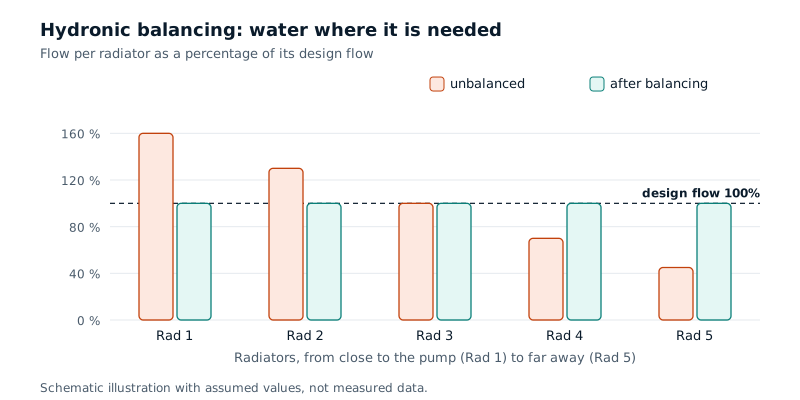
Figure 1: Flow distribution with and without hydronic balancing. Schematic illustration, not measured data.
The German technical rule on balancing summarises the benefits plainly: only a balanced system allows system temperatures to be lowered as far as possible; correct flows and lower pressure differences reduce pump electricity; and balancing prevents valve noise and under-heated rooms [4].
Worked example: how much water does a kilowatt need?
Worked example (our own calculation with textbook values): the flow an emitter needs depends on its output and on the temperature difference between flow and return (ΔT). With water at about 4.19 kJ/(kg·K) and about 1 kg per litre, 1 kW of heat needs:
| Design ΔT | Typical use | Flow per kW |
|---|---|---|
| 5 K (9 °F) | heat pump systems | about 0.048 l/s (172 l/h) |
| 11 K (20 °F) | traditional 82/71 °C boiler design | about 0.022 l/s (78 l/h) |
| 20 K (36 °F) | low-flow designs | about 0.012 l/s (43 l/h) |
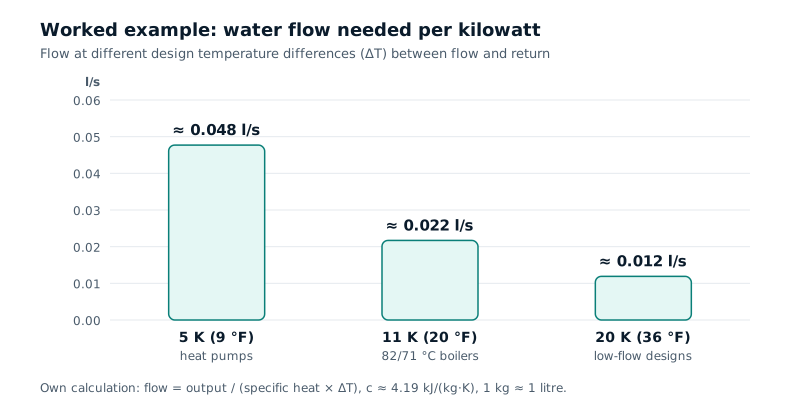
Figure 2: Flow needed per kilowatt at different design temperature differences. Own calculation.
Two lessons follow. First, a heat pump system with a small ΔT moves roughly four times as much water per kilowatt as a 20 K design, so imbalance shows up quickly when an old boiler system is converted. Second, pump power rises roughly with the cube of flow under the pump affinity laws: 20% less flow means, in theory, about half the pump power (0.8³ ≈ 0.51) [8]. Real savings are smaller, but the direction is clear.
Common mistakes
- Raising the flow temperature instead of fixing the flows. It hides the symptom and makes condensing boilers and heat pumps less efficient [4].
- Setting valves by feel. Without a room-by-room heat loss calculation there is no design flow to balance to. German law requires one where balancing is mandatory [1].
- Balancing once and never checking. Refits and changes of use undo the work. Nobody notices without room temperature data.
- Leaving the heating curve unchanged. The point of balancing is to lower the flow temperature afterwards; if the weather compensation curve is not adjusted, much of the benefit is lost [1][4].
- Ignoring schedules. Balancing does not replace sensible operating times. Commercial buildings stand empty at night and at weekends; see our guide to reducing energy costs in commercial buildings.
What guidance and rules say
| Source | Country | What it covers |
|---|---|---|
| CIBSE Commissioning Code W, Water distribution systems (2010) | UK | Pre-commissioning, setting pumps to work, balancing and regulating water flow rates; archived by CIBSE in June 2025 [5] |
| BSRIA BG 2, Commissioning water systems (2010) | UK | Step-by-step procedures, used with Code W, including low-flow circuits [6] |
| ASHRAE Standard 111 | US | Measurement, testing, adjusting and balancing of HVAC systems, including hydronic systems [7] |
| § 60c GModG (formerly the Building Energy Act) | Germany | Mandatory balancing after a new water-based heating system is installed in buildings with six or more dwellings or other independent units, using a room-by-room heat load calculation (“method B”) [1] |
Table 1: Guidance and rules on hydronic balancing. Status October 2026.
The German rule is unusually specific: it requires a room-by-room heat load to DIN EN 12831-1, a check of the emitters so that the lowest possible flow temperature can be used, adjustment of the flow temperature control, and a written record of the settings [1]. Even where no rule applies, the same steps make sense.
What balancing achieves – and what is proven
| Effect | Evidence | Limits |
|---|---|---|
| Heat use | 2.5–16 kWh/(m²·a), about 10 on average, in German studies (TU Dresden ITG, Ostfalia) [3] | Mostly homes; no measurable saving in buildings built before 1977 in the OPTIMUS project [2] |
| Pump electricity | Lower flows and pressures reduce pump power [4][8] | Depends on pump type and control |
| Comfort | More even temperatures, faster warm-up, less valve noise [2][4] | Does not fix undersized emitters or poor insulation |
Table 2: Documented effects and their limits.
Because commercial data is thin, treat any savings figure as a hypothesis to test on your own building: weather-normalised consumption before and after, plus room temperatures. Balancing often belongs in a wider retro-commissioning exercise rather than standing alone.
How a balancing job runs
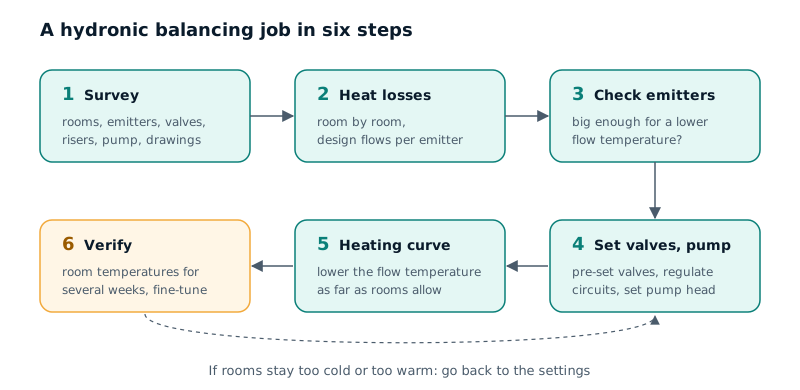
Figure 3: A balancing job with a final check. Simplified, own illustration based on [1][4][5].
- Survey: rooms, emitters, valves, risers, pump, existing drawings.
- Calculate heat losses room by room and derive design flows.
- Check emitters: can each room be heated at a lower flow temperature? The worst room sets the system temperature [4].
- Set valves and the pump: pre-set radiator valves, regulate circuits, set the pump to the required head.
- Adjust the heating curve as far as the rooms allow.
- Verify: measure temperatures in the critical rooms for several weeks and fine-tune.
The work is done by a heating contractor or commissioning specialist. Step 6 is the one most often skipped.
How Nebatic helps
Nebatic measures temperature, humidity and CO₂ continuously, room by room. Before balancing, the histories show which zones are always overheated and which stay cool, including at night and at weekends. Afterwards, the same rooms show whether the settings worked and whether the heating curve can come down further. See finding the causes of high heating costs and reducing heating costs with room data.
Nebatic does not balance systems or calculate heat losses. It provides the data that contractors and operators need to judge the starting point and the result.
Risks and limits
- Specialist work: heat loss calculations, valve settings and changes to pumps and controls belong with qualified contractors.
- No savings promise: the published figures come mostly from homes and vary widely [2][3]. Only your own before-and-after data shows what your building saves.
- Hydraulics are not everything: balancing evens out flows; it does not make small radiators bigger or draughty windows tight.
- Rules differ by country: check which regulations and standards apply to your site.
Hydronic balancing: quick answers
What is hydronic balancing?
Adjusting the water flow in a heating or cooling system so that each emitter and circuit receives its design flow. It prevents near rooms from overheating while far rooms stay cold [4].
How do I know if my heating system needs balancing?
Typical signs are rooms at very different temperatures, noisy valves, a pump on a high setting and a high flow temperature even in mild weather [4]. A few weeks of room temperature data make the pattern visible.
Does hydronic balancing save energy?
Often, but not always. German studies in homes found 2.5–16 kWh per m² a year [3]; in older buildings the OPTIMUS project measured practically no saving [2]. The main gain is that it allows a lower flow temperature.
Is hydronic balancing required by law?
In Germany, after a new water-based heating system is installed in buildings with six or more dwellings or other independent units [1]. In the UK and US, balancing is part of commissioning guidance rather than a general legal duty [5][7].
Why does balancing matter for heat pumps?
Heat pumps work best at low flow temperatures and small temperature differences, which means higher water flows per kilowatt. An unbalanced system forces higher flow temperatures and cuts efficiency.
Sources
- Gebäudemodernisierungsgesetz (GModG), § 60c Hydraulic balancing and other measures to optimise heating systems (German). https://www.gesetze-im-internet.de/geg/__60c.html
- Jagnow, K.; Wolff, D. / Verband für Wärmelieferung (2007): OPTIMUS – summary of project results (German). https://vedec.kbit.de/wp-content/uploads/2020/10/zusammenfassung_Optimus.pdf
- Deutsche Umwelthilfe (March 2022): Fact sheet on hydronic balancing of heating systems (German). https://www.duh.de/fileadmin/user_upload/download/Projektinformation/Energieeffizienz/Gebaeude/FactSheet_hydraulischer_Abgleich_Mzr2022.pdf
- VdZ – Forum für Energieeffizienz in der Gebäudetechnik (2016): Technical rule on hydronic balancing, version 1.2 (German). https://zvshk.de/fileadmin/migratedNewsAssets/Files/Fachregel_hydraulischer-Abgleich.pdf
- CIBSE: Commissioning Code W – Water distribution systems (2010), archived June 2025. https://www.cibse.org/knowledge-research/knowledge-portal/commissioning-code-water-distribution-systems-2010
- Heating & Ventilating Review (2 September 2010): CIBSE/BSRIA commissioning water systems guides. https://www.heatingandventilating.net/cibsebsria-commissioning-water-systems-guides-
- ASHRAE Standard 111: Measurement, Testing, Adjusting, and Balancing of Building HVAC Systems (record at GlobalSpec). https://standards.globalspec.com/std/1248216/ashrae-std-111
- Held, E. (2015): How the affinity laws work – linear, quadratic, cubic. SBZ Monteur 05/2015 (German). https://www.sbz-monteur.de/sites/default/files/sbzm_pdf/file_650348.pdf