General information, not legal advice (status: October 2026). This article explains the EU rule and, as a worked case, the German rules (Building Modernisation Act, Gebäudemodernisierungsgesetz, GModG); other EU countries implement the EU directive in their own laws. The binding German text is § 56 GModG on gesetze-im-internet.de.
Key points
- BACS requirements in the EU come from Article 13 of the recast Energy Performance of Buildings Directive (EPBD), Directive (EU) 2024/1275: non-residential buildings with heating, air-conditioning or combined ventilation systems above 290 kW had to have building automation and control systems (BACS) by the end of 2024; those above 70 kW must follow by 31 December 2029, where technically and economically feasible [10][21].
- The directive describes functions, not products, including continuous energy monitoring, detection of efficiency losses, interoperability and indoor environmental quality monitoring [10][21].
- Germany is a clear example of how the rule reaches national law. The old threshold of 290 kW (§ 71a GEG, deadline end of 2024) has been replaced by § 56 GModG, in force since 29 July 2026: more than 70 kW, deadline 31 December 2029, plus automatic lighting controls [1][2][5][6].
- Exemptions exist only where equipping the building is technically not possible or economically unreasonable, and both have to be justified case by case [1][3][4].
- Owners who start now with an inventory and measurement have time for design, tendering and proper commissioning; waiting until shortly before 2029 means planning under time pressure.
BACS requirements under EPBD Article 13: what the EU asks for
Building automation and control systems (BACS) are the controls, sensors, meters and software that run and supervise heating, cooling, ventilation and lighting. For larger non-residential buildings, the EU makes them a legal duty through the Energy Performance of Buildings Directive. The current version is the recast directive, Directive (EU) 2024/1275, adopted on 24 April 2024 [21].
The core rule is in EPBD Article 13, paragraph 9. Member States must require that non-residential buildings are equipped with BACS, where technically and economically feasible, in two stages based on the effective rated output of heating systems, air-conditioning systems, systems for combined space heating and ventilation or systems for combined air-conditioning and ventilation [10][21]:
- above 290 kW: by 31 December 2024
- above 70 kW: by 31 December 2029
The practical effect of the BACS requirements lies in how many buildings they now reach. The 70 kW stage pulls in mid-sized offices, schools, shops, hotels and practices that were well below the first threshold.
The capabilities every BACS must have
Paragraph 10 of Article 13 lists what the systems must be able to do. In short, they must [10][21]:
- continuously monitor, log and analyse energy use and allow it to be adjusted;
- benchmark the building’s energy efficiency, detect losses of efficiency in technical building systems and inform the person responsible for the building or its technical management about possible improvements;
- allow communication with connected technical building systems and be interoperable with technical building systems across different proprietary technologies, devices and manufacturers;
- by 29 May 2026, be able to monitor indoor environmental quality.
Point 4 matters for anyone planning now: a BACS that only watches the plant room no longer matches the directive’s wording.
Lighting controls
Paragraph 12 adds automatic lighting controls for non-residential buildings above the same thresholds, again where technically and economically feasible: by 31 December 2027 above 290 kW and by 31 December 2029 above 70 kW. The controls must be suitably zoned and capable of occupancy detection [21]. National laws can set the details differently, as the German example below shows.
Who is affected: the 70 kW threshold explained
Three conditions decide whether a building is covered, in the directive and in the German law alike [1][10]:
- Non-residential building. Residential buildings are not covered by this duty (the directive has separate rules for new residential buildings and those undergoing major renovation [21]). Typical cases are offices and administrative buildings, retail, schools, hotels, medical practices, halls and mixed-use buildings that are mainly non-residential.
- Type of system. Heating systems, combined space heating and ventilation systems, air-conditioning systems and combined air-conditioning and ventilation systems [1].
- Rated output above 70 kW. What counts is the rated (nominal) output of the system, not actual consumption.
With several heat generators, separate heating and cooling systems or several tenancies, it is not always obvious which output counts. The German wording speaks of the “rated output of a heating system” or of the respective system [1]. Agree the approach with an energy consultant or building services engineer and put the result in writing.
For owners and operators, the first question is therefore documentary: are rating plates, system documentation and output data complete? Without them, nobody can say for sure whether the building is in scope.
Germany as a case: from GEG § 71a to GModG § 56
Germany shows how the EU stages become a national duty, which matters for owners and investors with German assets. Until July 2026, GEG building automation rules sat in § 71a of the Buildings Energy Act (Gebäudeenergiegesetz, GEG). They required BACS only for non-residential buildings with a heating system or combined space heating and ventilation system of more than 290 kW rated output, to be installed by the end of 2024 [6]. The law of 23 July 2026 (BGBl. 2026 I No. 226) renamed the GEG as the Building Modernisation Act (GModG). § 71a was repealed with effect from 29 July 2026, and the rule now sits in § 56 [2][5][8]. Owners who were below the old 290 kW limit, for example in many office buildings, should check their position again.
The core of § 56 (1) reads, in translation: a non-residential building with a heating system, a combined space heating and ventilation system, an air-conditioning system or a combined air-conditioning and ventilation system “of more than 70 kilowatts” must be equipped “by the end of 31 December 2029” with a system for building automation and control, “unless equipping it is technically not possible or economically unreasonable” [1]. With this, Germany has implemented the second EU stage [10].
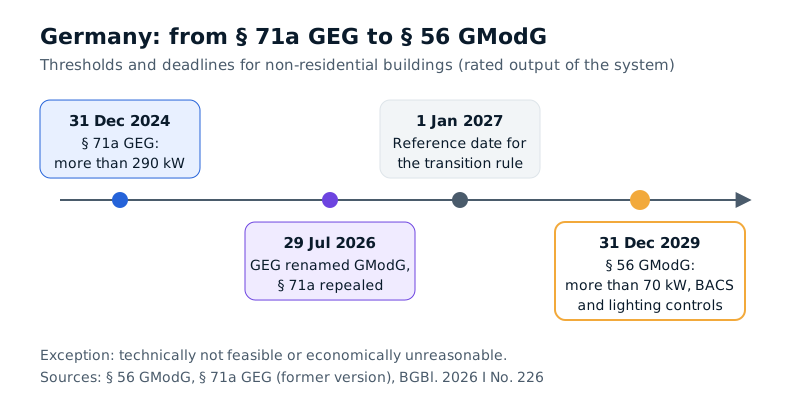
Figure 1: Germany’s move from the 290 kW rule in § 71a GEG to the 70 kW rule in § 56 GModG. Sources: [1][2][5][6].
The German Energy Agency (dena) estimates the stock of office and administrative buildings in Germany at around 329,000 buildings with about 395 million square metres of floor area (end of 2022). They use around 86.6 terawatt-hours of final energy (2021), which is 27% of the commerce, trade and services sector [19]. How many of them are above 70 kW has not been quantified publicly. A parliamentary question in the Bundestag in September 2026 asks for this figure, but only for non-residential buildings owned by the federal government [9].
Special cases in the German law
- Recently installed systems (para. 4): if a BACS that does not meet the requirements of para. 2 was installed in an existing non-residential building in the three years before 1 January 2027, the owner may upgrade it after 31 December 2029; the period for this is ten years [1]. When those ten years start should be clarified legally in each case.
- National and allied defence (para. 5): federal buildings and companies with federal participation that serve national and allied defence are exempt [1].
- New buildings (para. 3): additional minimum standards apply (see the box on German automation grades below).
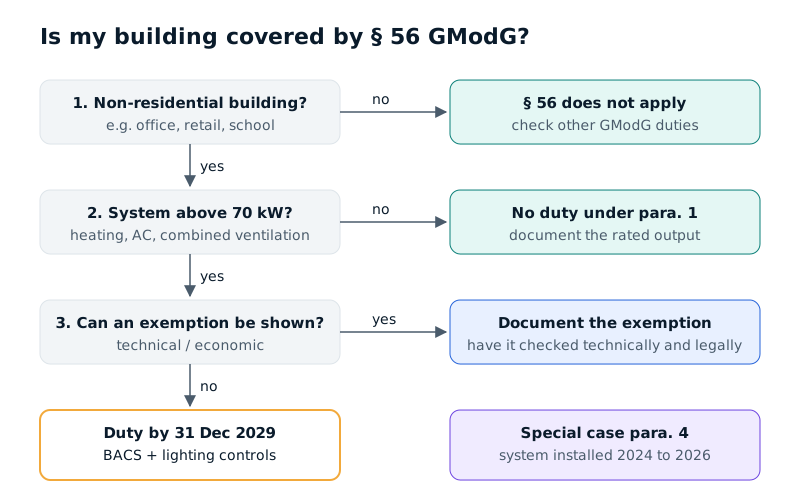
Figure 2: Simplified check of whether a building falls under § 56 GModG. Own illustration based on [1]; it does not replace a case-by-case assessment.
Exemptions: technically not possible or economically unreasonable
§ 56 (1) names two exemptions but does not define them. Two general provisions of the GModG help with interpretation.
Economic viability (§ 5): requirements count as economically justifiable if the necessary expenditure can be recovered through the resulting savings within the usual service life; for existing buildings and systems, the remaining expected service life is taken into account [4].
Exemption on application (§ 102): the authority responsible under state law grants an exemption on application if requirements would cause undue hardship in the individual case. Undue hardship exists in particular if the expenditure cannot be recovered through savings or if the investment is out of proportion to the value of the building. Expected energy price developments, including CO₂ prices from emissions trading, must be considered [3].
The wording does not say whether the exemption in § 56 applies automatically or needs an application under § 102. Anyone relying on it should document it clearly and have it checked legally.
Worked example (illustrative, logic only): assume a retrofit costs the amount I, and the proven annual saving in energy costs is E. The simple payback period is then I divided by E. If the remaining service life of the system is shorter than this payback period, that points towards economic unreasonableness under the logic of § 5. Assumptions: constant energy prices, no financing costs, no grants. In practice these assumptions are rarely met, and § 102 explicitly requires price developments and CO₂ prices to be included [3]. A robust viability assessment therefore comes from an energy consultant or building services engineer, not from a rule of thumb.
What the system must do: German para. 2 next to the EU list
§ 56 (2) GModG turns the EU capabilities into six functions. Like the directive, it describes functions, not products. The system must be able to [1]:
| No. | Requirement under § 56 (2) GModG | What it means in practice |
|---|---|---|
| 1 | continuously monitor, log and analyse the consumption of all main energy carriers and all technical building systems, and adjust consumption | Meters and sub-meters for heat, electricity and, where relevant, gas and cooling; data stored at short intervals; the controls act on it |
| 2 | make the collected data available through a common, freely configurable interface, so that analysis is independent of company and manufacturer | Open, documented interface; the data does not belong only to the manufacturer |
| 3 | set reference values for the building’s energy efficiency | Define target values or benchmarks to measure against |
| 4 | detect efficiency losses in technical building systems | Spot deviations, e.g. heating when nobody is there, heating and cooling at the same time |
| 5 | inform the operator about possible energy efficiency improvements | Alerts must reach the responsible people and be acted on |
| 6 | monitor indoor climate quality | Measure indoor climate parameters in occupied rooms |
Table 1: Requirements under § 56 (2) GModG (wording shortened) and their practical meaning. Source: [1].
Projects often underestimate two points. The open interface (no. 2): a closed system whose data can only be read with one vendor’s software is unlikely to meet it. And indoor climate quality (no. 6), which comes from Article 13(10) of the EPBD [10].
What “indoor climate quality” means in practice
§ 56 does not define indoor climate quality. Temperature, relative humidity and CO₂ (an indicator of air exchange) are the usual parameters. For CO₂, the German Committee on Indoor Air Guide Values at the German Environment Agency rates concentrations below 1,000 ppm as hygienically harmless, 1,000 to 2,000 ppm as hygienically conspicuous and above 2,000 ppm as hygienically unacceptable [20]. That means measuring where people work, not only in the plant room.
Automatic lighting controls in Germany (para. 6)
§ 56 (6) also requires automatic lighting controls in non-residential buildings above 70 kW by the end of 2029, where technically possible and economically reasonable. They “shall be suitably zoned and have occupancy detection” [1]. In a study by Biberach University of Applied Sciences for the German electrical industry association ZVEI, presence-dependent switching reduced the lighting energy demand of a simulated seminar room by 19 to 36%, and presence- and daylight-dependent switching by 32 to 46% [15]. The authors stress that the results only transfer to buildings with similar conditions and depend strongly on user behaviour [15].
EN ISO 52120 class B and the efficiency classes
The European and international standard for the energy impact of building automation is EN ISO 52120-1 (“Energy performance of buildings – Contribution of building automation, controls and building management – Part 1: General framework and procedures”). In Germany it is published as DIN EN ISO 52120-1:2025-02 and replaces DIN EN 15232-1:2017-12. It contains a structured list of automation functions and a factor-based method for a first estimate of their effect [12].
The standard sorts building automation into four efficiency classes. The overview below follows the summary of a lecture at Esslingen University of Applied Sciences [14] and the description by Becker and Knoll [16]:
| Class | Short description | Typical features |
|---|---|---|
| A | high energy performance | demand-controlled, networked room automation; optimised primary plant; energy monitoring and continuous optimisation |
| B | advanced | room automation and optimised primary plant; energy monitoring; partly technical monitoring |
| C | standard (reference class) | control of primary plant, time schedules with setback; no room automation, no energy monitoring |
| D | not energy efficient | no networking, fixed-value control, no setback, no room control |
Table 2: Efficiency classes of building automation under EN ISO 52120-1, simplified. Sources: [12][14][16].
Neither the EPBD nor § 56 prescribes a class for existing buildings; what counts are the functions listed above. Legal commentary also points out that § 56 creates a rule of its own, with monitoring, analysis and indoor climate functions [11]. Owners who still choose EN ISO 52120 class B as the target for an existing building gain a clear planning basis. One precondition is continuous building monitoring, because energy monitoring is a feature of classes A and B.
Box: German automation grades for new buildings. For new non-residential buildings, § 56 (3) requires at least automation grade B under DIN/TS 18599-11:2025-10 above 290 kW and at least grade C above 70 kW, plus technical commissioning management including balancing and tuning of the building services; the system should also allow communication between connected systems and work across manufacturers [1]. DIN/TS 18599-11:2025-10 is the German standard part on building automation and replaces DIN V 18599-11:2018-09 [13]. ISO classes and DIN/TS grades are not automatically the same; the required functions follow from the standard’s text.
What building automation achieves: the evidence
The duty rests on expected energy savings. Research shows:
- Simulation for US commercial buildings: in 2017 the Pacific Northwest National Laboratory simulated, for the US Department of Energy, efficiency measures that rely mostly on building controls in typical commercial buildings. If they were implemented nationwide, annual energy use of commercial buildings would fall by 29% on average. The largest single contributions came from adjusted heating and cooling setpoints (about 8%), reduced minimum airflow in variable air volume systems (about 7%) and running systems only during likely occupancy (about 6%) [17]. Limit: these are model calculations for US building types and climates; real savings may differ.
- Measurement and simulation in Germany: for ZVEI, Becker and Knoll (Biberach University of Applied Sciences) compared seminar rooms of classes A, B and C in real operation and added simulations. Lowering the heating setpoint by 1 kelvin saved about 6.9 to 8.2% of heating energy in the simulation, and a night setback from 20 to 16 °C about 6 to 12%, depending on the type of construction [15]. Limit: few rooms, one building, strong influence of user behaviour [15][16].
- Commissioning and tuning: an analysis by Lawrence Berkeley National Laboratory covering 643 buildings found a median energy saving of 16% with a median payback of 1.1 years for commissioning of existing buildings; for new buildings the figure was 13% [18]. Limit: US data, voluntarily documented projects, status 2009.
Two lessons follow. The potential is real, but it comes from correct setpoints, suitable schedules and ongoing review, not from hardware alone. And results depend on the starting point: a building already run efficiently saves less than one with poorly set controls.
Building automation system cost: what drives it
The official sources reviewed give no generally valid retrofit prices, and the German government bill states no cost figures for building automation [7]. More useful is a look at what drives building automation system cost:
- Starting point: is there already a building management system (BMS), controllable valves and actuators, and meters? Or does the project start from zero?
- Metering structure: the German para. 2 no. 1 requires all main energy carriers and technical building systems to be recorded. Missing sub-meters are often a large item.
- Interfaces: old, manufacturer-bound systems without an open interface make the interoperability requirement harder to meet.
- Room level: indoor climate measurement and lighting controls with occupancy detection scale with the number of rooms and zones.
- Cabling and building work: work during operation, fire protection and listed-building rules increase the effort.
- Design, commissioning, operation: tuning, documentation, training and ongoing analysis are services in their own right and are often underbudgeted.
This is also where the question of BMS vs IoT monitoring comes up. A BMS controls plant; wireless sensors can add room-level measurement where cabling would be costly. They complement each other: control functions still need a BACS, while sensors close monitoring gaps. A building analysis before tendering narrows down these cost items. Funding questions go to an energy consultant or, in Germany, to BAFA or KfW.
BACS compliance checklist: six steps for existing buildings
The 2029 deadline seems far away. Add up inventory, measurement phase, design, tendering, installation and commissioning over at least one heating season, and time gets tight. For facility management teams, a sequence of six steps works well as a BACS compliance checklist:
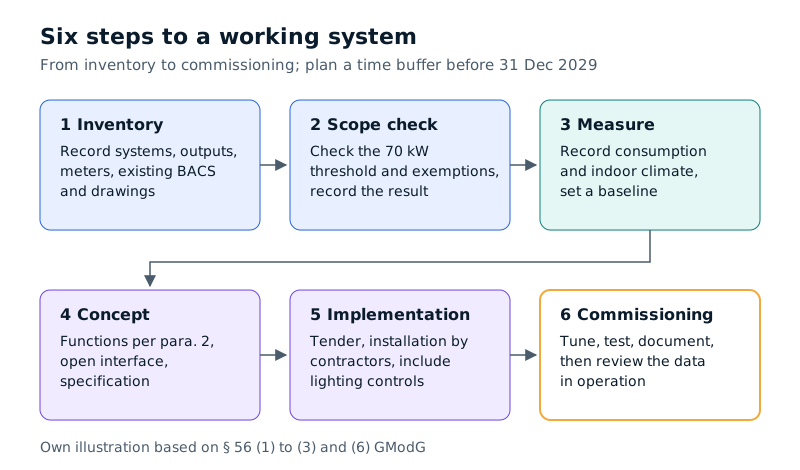
Figure 3: Sequence from inventory to commissioning. Own illustration based on [1].
1. Take stock. Systems with rated outputs, existing controls and BMS, meters, lighting, drawings, maintenance contracts. Documentation gaps show up here.
2. Check and record whether the building is in scope. 70 kW threshold, special case under para. 4, possible exemptions. The result belongs in writing in the building file, ideally with an energy consultant’s assessment.
3. Measure before you plan. A measurement phase delivers load profiles, operating hours and indoor climate data: where energy is used outside occupied hours, and which rooms are too warm, too cold or poorly ventilated. The same baseline later proves savings and supports the viability assessment.
4. Concept and specification. Describe functions along the six points of para. 2, define interfaces (open, documented, manufacturer-independent), define lighting zones, and decide who handles alerts and alarms.
5. Implementation. Award contracts to design engineers and installers. In existing buildings, this often means connecting existing meters and controllers instead of replacing them.
6. Commissioning and operation. Tune, test and document the functions. For new buildings in Germany, technical commissioning management is mandatory [1]; for existing buildings it makes just as much sense, as the commissioning data above show [18]. Then the real work starts: reading alerts, finding causes, adjusting setpoints.
Common mistakes
- Starting too late. Near the deadline, many buildings will be retrofitted at once, and commissioning across a heating season takes time.
- Getting the output wrong. Judge the 70 kW limit by rated output in the system documentation, not by feel or consumption.
- Claiming an exemption without proof. “Too expensive” is not a justification without a viability assessment along the lines of § 5 and § 102 [3][4].
- Buying closed systems. Without an open, configurable interface, para. 2 no. 2 is hard to meet [1].
- Forgetting indoor climate. Para. 2 no. 6 explicitly requires it [1].
- Installing and then ignoring it. A system whose alerts nobody reads saves no energy; savings come from operation [17][18].
- Planning lighting separately. The lighting duty under para. 6 has the same deadline.
How Nebatic helps
Nebatic provides measured data as a basis for the BACS requirements, especially for monitoring indoor climate quality (German para. 2 no. 6, EPBD Article 13(10)) and for a data-based inventory. The Nebatic Core and Nebatic AirSense devices record parameters including CO₂, particulate matter, VOC, temperature and humidity. The platform shows live values, trends, anomalies and alerts. Existing sensors, meters and building systems can be connected, and data can flow through interfaces into CAFM, BI or ESG tools.
To be clear about its role: Nebatic is a measurement and monitoring solution, not a classic building automation system. Nebatic does not install control systems or a BMS; it works with installers and system integrators. Whether a building meets the duty under § 56 or the national equivalent depends on the system as a whole and is assessed by design engineers, energy consultants and, where needed, legal advisers. Nebatic does not guarantee legal compliance.
Limits and risks
- Not legal advice. This article summarises the legal texts (status: October 2026). Questions of interpretation, such as how to determine output with several systems, how § 56 relates to § 102, or when the period under para. 4 starts, should be clarified with a lawyer or the responsible state authority. Outside Germany, the national transposition law applies.
- Standards are paid documents. The exact requirements of the automation grades are in DIN/TS 18599-11 and EN ISO 52120-1. This article only gives a simplified view.
- Savings figures do not transfer. The studies cited are based on simulations, few rooms or US buildings. For your building, your own measurement and assessment count.
- Indoor climate and health. CO₂ or particulate readings guide ventilation and operation; they are not a medical assessment. For health complaints, a doctor or occupational health service is the right contact.
- Who does what. Energy consultant: viability, funding questions. Building services engineer: concept, automation grades, specification. Contractors: installation and tuning. Authority: exemptions under § 102.
Frequently asked questions
What are the BACS requirements in the EPBD?
Article 13 of Directive (EU) 2024/1275 requires non-residential buildings with heating, air-conditioning or combined ventilation systems above 290 kW (by the end of 2024) and above 70 kW (by 31 December 2029) to have building automation and control systems, where technically and economically feasible. The systems must monitor energy use, benchmark efficiency, detect losses, alert the responsible people, work across manufacturers and monitor indoor environmental quality [10][21].
Does the 70 kW building automation rule apply to existing buildings?
Yes. In Germany, § 56 (1) GModG covers non-residential buildings in general, including existing ones. For new buildings, para. 3 adds minimum automation grades and technical commissioning management [1].
Which threshold applies in Germany, 70 kW or 290 kW?
For the duty to install, the threshold since the GModG is more than 70 kW. The 290 kW limit comes from the repealed § 71a GEG and now only plays a role for new buildings: there, § 56 (3) requires automation grade B above 290 kW and grade C above 70 kW [1][5].
What changed from GEG § 71a to GModG § 56?
The threshold dropped from 290 to 70 kW, with a deadline of 31 December 2029. New are the open interface, indoor climate monitoring, lighting controls and, for new buildings, minimum automation grades [1][6].
Can the 2029 deadline be postponed?
In principle, no. In Germany there is an exception under para. 4 for buildings in which a system that does not meet para. 2 was installed in the three years before 1 January 2027: these may be upgraded after 31 December 2029, with a period of ten years [1]. Apart from that, there are the exemptions for technical impossibility and economic unreasonableness.
Do I need EN ISO 52120 class B?
For existing buildings, neither the EPBD nor § 56 names a class; they list functions. For new buildings above 290 kW, the German law requires automation grade B under DIN/TS 18599-11, not explicitly a class under EN ISO 52120 [1]. Class B can still be a sensible design target.
How much does a building automation system cost?
It depends on existing equipment, metering, interfaces, number of rooms and building work. There are no generally valid official cost figures [7]; an inventory with a measurement phase is the basis for a reliable estimate.
Is indoor air quality monitoring mandatory?
Within the BACS duty, yes. The EPBD requires BACS to be able to monitor indoor environmental quality by 29 May 2026 [21], and in Germany the system must be able to monitor indoor climate quality under § 56 (2) no. 6 [1]. The law does not say which parameters; temperature, humidity and CO₂ are the usual ones.
Sources
- Federal Ministry of Justice / Federal Office of Justice (2026): Gebäudemodernisierungsgesetz (GModG), § 56 Gebäudeautomatisierung und Gebäudesteuerung [Building automation and control]. https://www.gesetze-im-internet.de/geg/__56.html
- Federal Ministry of Justice / Federal Office of Justice (2026): Gebäudemodernisierungsgesetz (GModG), full text, last amended by Art. 4 of the Act of 23.7.2026 (BGBl. 2026 I No. 226). https://www.gesetze-im-internet.de/geg/GModG.pdf
- Federal Ministry of Justice / Federal Office of Justice (2026): GModG, § 102 Befreiungen [Exemptions]. https://www.gesetze-im-internet.de/geg/__102.html
- Federal Ministry of Justice / Federal Office of Justice (2026): GModG, § 5 Grundsatz der Wirtschaftlichkeit [Principle of economic viability]. https://www.gesetze-im-internet.de/geg/__5.html
- buzer.de (2026): § 71a GEG (repealed by Art. 1 of the Act of 23.07.2026, BGBl. 2026 I No. 226, with effect from 29.07.2026). https://www.buzer.de/71a_GEG.htm
- lxgesetze.de: § 71a GEG Gebäudeautomation [Building automation] (version before 29.07.2026: more than 290 kW, by 31.12.2024). https://lxgesetze.de/geg/71a
- German Bundestag (2026): Government bill, draft act amending the Buildings Energy Act …, printed paper 21/6278. https://dserver.bundestag.de/btd/21/062/2106278.pdf
- Bundesrat (2026): Act adopted by the German Bundestag, printed paper 409/26. https://dserver.bundestag.de/brd/2026/0409-26.pdf
- German Bundestag (2026): Minor interpellation “Folgen des Gebäudemodernisierungsgesetzes (vormals Gebäudeenergiegesetz) für die Bauten des Bundes und der Bundesministerien” [Consequences of the Building Modernisation Act for federal buildings], printed paper 21/7797. https://dserver.bundestag.de/btd/21/077/2107797.pdf
- European Parliament and Council (2024): Directive (EU) 2024/1275 on the energy performance of buildings, Article 13 (consolidated German text). https://gesetze.legal/eu/rl_2024_1275_eu/13
- Rödl & Partner (2026): Neues Gebäudemodernisierungsgesetz (GModG): Systemwechsel gegenüber Gebäudeenergiegesetz [New Building Modernisation Act: a change of system compared with the Buildings Energy Act]. https://www.roedl.com/insights/neues-gebaeudemodernisierungsgesetz-gmodg-systemwechsel-gegenueber-gebaeudeenergiegesetz/
- DIN Media (2025): DIN EN ISO 52120-1:2025-02 Energy performance of buildings – Contribution of building automation, controls and building management – Part 1: General framework and procedures. https://www.dinmedia.de/de/norm/din-en-iso-52120-1/345026735
- DIN Media (2025): DIN/TS 18599-11:2025-10 Energy efficiency of buildings – Part 11: Building automation. https://www.dinmedia.de/en/pre-standard/din-ts-18599-11/389789965
- Esslingen University of Applied Sciences (2021): Gebäudeautomation – nichts dem Zufall überlassen [Building automation – leave nothing to chance] (report on the colloquium lecture of 19.05.2021). https://www.hs-esslingen.de/fileadmin/media/Fakultaeten/ng/Fakultaet/Aktuelles/Vortr%C3%A4ge/Geb%C3%A4udeautomation_-_nichts_dem_Zufall_%C3%BCberlassen_19.5.2021.pdf
- Becker, M.; Knoll, P. / Biberach University of Applied Sciences for ZVEI (2011): Energieeffizienz durch Gebäudeautomation – Kurzfassung [Energy efficiency through building automation – summary]. https://www.zvei.org/fileadmin/user_upload/Verband/Fachverbaende/Elektroinstallationssysteme/Studie_Energieeffizienz_durch_Gebaeudeautomation/Kurzfassung-ZVEI-Studie-Energieeffizienz-durch-Gebaeudeautomation.pdf
- Becker, M.; Knoll, P. (2014): Energy Savings and Energy Efficiency through Building Automation and Control. REHVA Journal 5/2014, pp. 46–50. https://rehva.eu/fileadmin/REHVA_Journal/REHVA_Journal_2014/RJ_issue_5/P.46/46-50_RJ1405_WEB.pdf
- Pacific Northwest National Laboratory (2017): Cut U.S. commercial building energy use 29% with widespread controls (on Fernandez, N. et al.: Impacts of Commercial Building Controls on Energy Savings and Peak Load Reduction). https://www.pnnl.gov/news-media/cut-us-commercial-building-energy-use-29-widespread-controls
- Mills, E. / Lawrence Berkeley National Laboratory (2009): Building Commissioning: A Golden Opportunity for Reducing Energy Costs and Greenhouse-gas Emissions. https://cx.lbl.gov/2009-assessment.html
- German Energy Agency (dena) (2023): Fokusthemen Büro- und Verwaltungsgebäude – Analyse der Nichtwohngebäudetypen, Teil 2 [Office and administrative buildings – analysis of non-residential building types, part 2]. https://www.gebaeudeforum.de/fileadmin/gebaeudeforum/Downloads/Gebaeudereport/Gebaeudeforum_GR24_Fokusthemen_Buerogebaeude.pdf
- German Environment Agency / Committee on Indoor Air Guide Values (2008, status 2022): Hygienische Leitwerte für Kohlendioxid in der Innenraumluft [Hygienic guide values for carbon dioxide in indoor air]. https://www.umweltbundesamt.de/system/files/medien/4031/bilder/dateien/hygienische_leitwerte_0.pdf
- European Parliament and Council (2024): Directive (EU) 2024/1275 of 24 April 2024 on the energy performance of buildings (recast), Official Journal of the EU, Article 13(9), (10) and (12). https://eur-lex.europa.eu/eli/dir/2024/1275/oj/eng