This article compares guidance from the UK, North America and Germany. Workplace rules differ by country; general information, not legal advice (status: October 2026).
In short
- Office humidity falls in winter for a simple physical reason: cold outdoor air holds little water, and heating it to room temperature makes its relative humidity drop sharply (worked example below).
- Most guidance sets no lower limit for humidity at work. ASHRAE Standard 55 does not specify a minimum humidity level [2], and a German review of the research found that dry air alone generally does not cause health problems [4].
- What guidance does set are upper limits, because too much humidity causes discomfort, condensation and mould [1][2][3].
- Complaints about dry air in the office often have other causes: rooms that are too warm, dust, draughts or emissions from furniture and equipment [5].
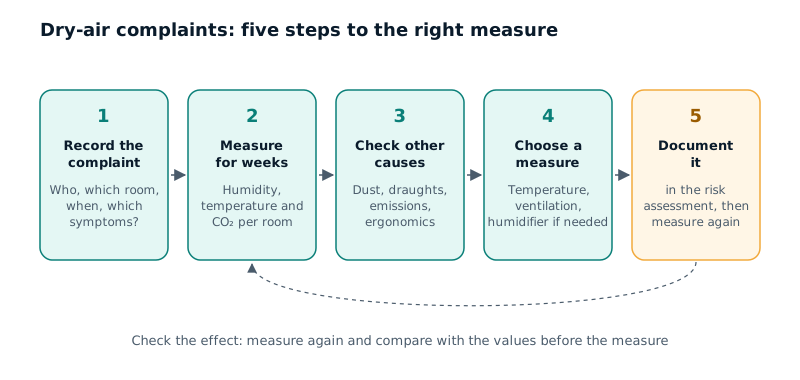
- Measure before you act. A few weeks of humidity, temperature and CO₂ data per room show whether the problem is the air, the heating or the ventilation – and whether a humidifier is worth its upkeep.
Why office air feels so dry in winter
Every heating season brings the same complaints: itchy eyes, dry skin, static shocks from the carpet, and someone asking whether the office needs a humidifier. Facilities teams then face two questions at once – is there really a problem, and what is the right fix?
The physics is straightforward. Relative humidity describes how much water the air holds compared with the most it could hold at that temperature. Warm air can hold far more water than cold air. When cold outdoor air is brought inside and heated, the amount of water stays the same, but the air could now hold much more – so its relative humidity falls [5].
Worked example (our own calculation with the Magnus formula; assumptions: outdoor air at 80 % relative humidity, heated to 21 °C, no moisture added indoors):
| Outdoor temperature | Relative humidity outdoors | Relative humidity after heating to 21 °C |
|---|---|---|
| 10 °C (50 °F) | 80 % | about 40 % |
| 5 °C (41 °F) | 80 % | about 28 % |
| 0 °C (32 °F) | 80 % | about 20 % |
| −5 °C (23 °F) | 80 % | about 14 % |
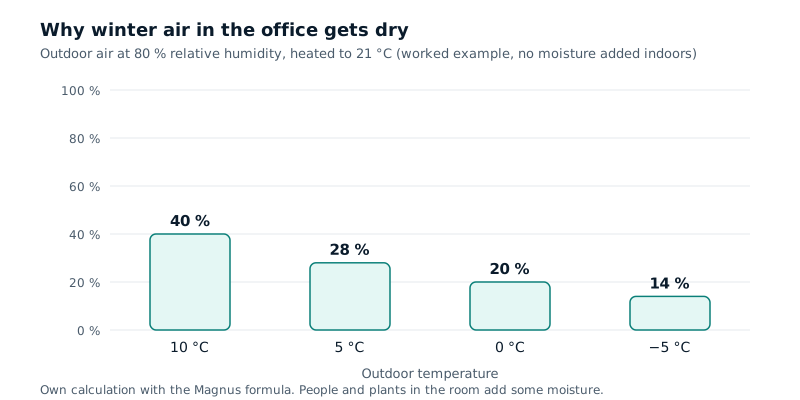
People, plants and coffee machines add some moisture, so real offices are usually a little more humid than this. The direction does not change: the colder it is outside and the more fresh air comes in, the drier the office becomes. That creates a real trade-off, because good air quality needs enough outdoor air – and in winter every bit of ventilation also dries the room.
What the guidance says about humidity at work
There is no single international rule for office humidity. The main sources agree more than they differ:
| Source | What it says about humidity |
|---|---|
| ASHRAE Standard 55 (US), as summarised by CCOHS | No established lower humidity limits for thermal comfort; the standard does not specify a minimum humidity level [2] |
| UK Health and Safety Executive (HSE) | Less sweat evaporates when humidity is high (over 80 %); workrooms should usually be at least 16 °C [1] |
| CCOHS (Canada) | Relative humidity below 20 % can cause discomfort through drying of the eyes, mucous membranes and skin; above 70 % may lead to condensation [2] |
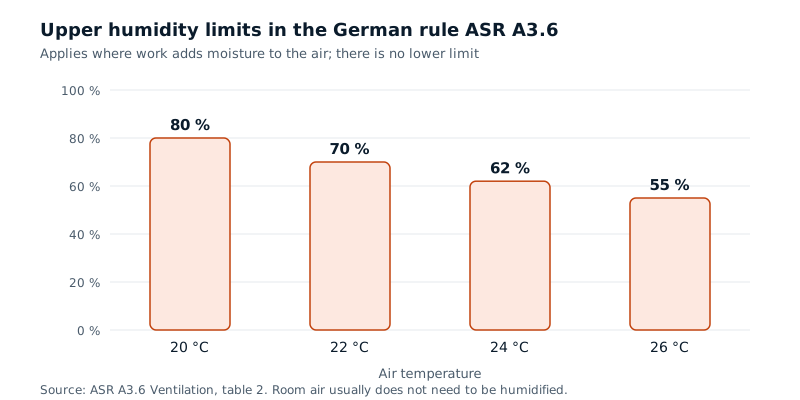
| German workplace rule ASR A3.6 | Upper limits only, e.g. 70 % at 22 °C and 55 % at 26 °C; room air usually does not need to be humidified [3] |
| German Social Accident Insurance (DGUV) | No lower guideline value; humidified HVAC systems are often designed for about 30 % [5] |
What does research say about dry office air?
The most thorough recent review comes from Germany. The Federal Institute for Occupational Safety and Health (BAuA) and the Institute for Occupational Safety and Health of the German Social Accident Insurance (IFA) analysed research from 2006 to 2019 – ten reviews and 27 laboratory, field and other studies. They found some effects of low humidity, such as drier skin and longer activity of influenza viruses. For the eyes and airways, other factors often mattered more. Their conclusion: the evidence does not yet support concrete measures such as humidifying workplaces in the cold season [4].
That does not mean humidity is irrelevant. An earlier IFA project considered a floor of 30–40 % sensible for speech-heavy work such as call centres, while noting that no medically justified limit could be found [6]. From about 30 %, static electricity also becomes less of a nuisance [5].
Common mistakes when the office feels dry
- Treating the symptom, not the cause. Complaints about dry air can come from temperature, air speed, dust or irritating substances, but also from workstation ergonomics and work organisation [5].
- Turning the heating up. Warmer air has an even lower relative humidity, and the office feels drier while the energy bill rises.
- Cutting ventilation to keep moisture in. Humidity barely changes, but CO₂ and other pollutants build up.
- Bowls of water on radiators. They add almost no humidity and can grow bacteria and mould [5].
- Portable humidifiers without maintenance. A German study tested five portable devices and found they only raised humidity effectively in rooms up to about 40 m² (about 430 sq ft), and that they were hard to clean [6].
- Deciding on one reading. A hygrometer value on Monday morning says little about the meeting rooms, the afternoon or the desk by the window.
What actually helps
| Measure | Effect | Limits |
|---|---|---|
| Check room temperature; avoid overheating | Relative humidity drops less; the room feels more comfortable | Respect minimum workplace temperatures |
| Ventilate on demand instead of leaving windows tilted | Enough fresh air without needlessly cooling and drying rooms | Watch CO₂ and humidity together |
| Look for dust, draughts and emissions | Removes common causes of irritation | Causes have to be found, not assumed |
| Drinks, breaks, some control over the room climate | Named by the DGUV as practical measures [5] | Not a substitute for finding the cause |
| Humidifier (central or portable) | Raises humidity where it is really low | Must be operated hygienically, following the manufacturer and VDI 6022 Part 1; steam humidifiers are recommended over other portable types [5]; respect upper limits |
When an office humidifier makes sense
A humidifier can be worth it when weeks of data show very low humidity, the other causes have been ruled out and the work involves a lot of talking [6]. Central systems should be designed and maintained to hygiene standards; portable units need regular cleaning. And humidity can overshoot: above the upper limits, it causes discomfort and condensation on cold surfaces, which can lead to mould [3][5].
Measure first
Relative humidity changes with the weather, occupancy, ventilation and heating. Reliable decisions need several weeks of data from the rooms concerned, together with temperature and CO₂. Only then can you tell whether the air is genuinely very dry, whether it happens only on cold days, or whether the real issue is temperature or ventilation. For the bigger picture, see our guide to indoor air quality in offices.
How Nebatic helps
Nebatic measures temperature, humidity and CO₂ continuously, room by room; Nebatic Core and Nebatic AirSense also record particulate matter and VOCs. The platform shows each room’s history over days and weeks, so you can see whether a dry-air complaint matches low humidity, a room that is too warm or too little ventilation – and check whether a measure worked. See Nebatic devices and having indoor air quality measured.
Risks and limits
- No medical assessment. Persistent eye, skin or airway symptoms belong with a doctor or occupational health service; conditions such as dry eyes or contact lenses can play a role [5].
- A reading is not a risk assessment. It is the evidence a risk assessment needs.
- HVAC changes need professionals. Humidification, set points and operating times belong with designers and contractors.
- Rules differ by country. Check the workplace regulations that apply to your site.
Office humidity: quick answers
What is a good humidity level for an office?
There is no single legal target. ASHRAE Standard 55 sets no minimum humidity [2], the German rule ASR A3.6 sets only upper limits such as 70 % at 22 °C [3], and humidified systems are often designed for about 30 % [5]. CCOHS notes that below 20 % can cause discomfort [2].
Why is the air in my office so dry in winter?
Cold outdoor air holds little water. Heated to room temperature, its relative humidity drops sharply – from 80 % at 0 °C outside to about 20 % at 21 °C, if no moisture is added indoors (worked example).
Is dry air in the office harmful?
A review of research from 2006 to 2019 by BAuA and IFA concluded that dry air alone generally does not cause health problems, although effects such as drier skin were observed [4]. See a doctor if symptoms persist.
Should we buy a humidifier for the office?
Only after measuring and ruling out other causes. Portable units only work in smaller rooms and need strict hygiene [5][6]; central humidification belongs with HVAC specialists.
How do you measure office humidity properly?
For several weeks, in the rooms concerned, at desk height and away from windows and radiators, together with temperature and CO₂. Single readings are easily misleading.
Sources
- UK Health and Safety Executive (HSE): Thermal comfort. https://www.hse.gov.uk/temperature/thermal/index.htm
- Canadian Centre for Occupational Health and Safety (CCOHS): Thermal Comfort for Office Work (citing ASHRAE Standard 55). https://www.ccohs.ca/oshanswers/phys_agents/thermal_comfort.html
- Committee for Workplaces / BAuA (2012, amended 2018): ASR A3.6 Lüftung (Ventilation), section 4 incl. table 2 “maximum relative humidity”, text via BGN. https://vorschriften.bgn-branchenwissen.de/daten/tr/asr_a3_6/4.htm
- Bux, K.; von Hahn, N. (2020): “Dry air” – literature study on the effects on health. BAuA, Dortmund. DOI 10.21934/baua:bericht20200624. https://www.baua.de/EN/Service/Publications/Report/Gd102
- DGUV (December 2025): DGUV Information 215-520 Klima im Büro (Office climate), chapter 2 on humidity. https://vorschriften.bgn-branchenwissen.de/daten/dguv/215_520/2.htm
- IFA: Project BGIA 3101 “Use of mobile humidifiers in office areas” (completed 12/2007). https://dguv.de/ifa/forschung/projektverzeichnis/bgia_3101.jsp