This article explains the German rules (Energy Efficiency Act, Energieeffizienzgesetz, EnEfG, and Energy Services Act, Energiedienstleistungsgesetz, EDL-G); other EU countries implement the EU Energy Efficiency Directive in their own laws. General information, not legal advice (status: October 2026). The legal text of the EnEfG is authoritative. An amendment bill is before the Bundestag but has not been adopted.
Key points
- The German Energy Efficiency Act ties duties to energy use, not company size. What counts is the average annual total final energy consumption over the last three completed calendar years [3][4][13].
- More than 2.5 GWh a year: confirmed and published implementation plans for economic saving measures, plus duties to avoid, reuse and report waste heat [4][10][11].
- More than 7.5 GWh a year: also an energy management system (ISO 50001) or EMAS, with statutory minimum content [3][13].
- Germany goes further than the EU directive. Article 11 of the Energy Efficiency Directive sets 85 TJ (about 23.6 GWh) for energy management systems and 10 TJ (about 2.8 GWh) for energy audits [31]; Germany’s 7.5 GWh threshold is much lower, and German law adds its own waste heat and data centre requirements [3][6][10][11].
- Data centres have their own duties on efficiency (PUE), renewable electricity, waste heat reuse, energy management and reporting [6][7][8][9]. Non-SMEs also need energy audits every four years under the EDL-G [15][16].
- Outlook: a 2026 government bill would raise the thresholds to 23.6 GWh and 2.77 GWh. As of October 2026 it has not been adopted [19][20][21].
The EU starting point: Article 11 of the Energy Efficiency Directive
For international groups with German sites, the easiest way into the German Energy Efficiency Act is the EU rule behind it. The recast Energy Efficiency Directive (EU) 2023/1791 of 13 September 2023 entered into force on 10 October 2023 [22]; member states had until 11 October 2025 to transpose it [30]. According to the European Commission, it extends the obligation to carry out energy audits to all companies above a certain energy consumption threshold and makes energy management systems mandatory for large energy consumers [30].
Article 11 of the EU Energy Efficiency Directive sets two thresholds, explained in a Commission recommendation on its interpretation [31]:
- Enterprises with an average annual energy consumption above 85 TJ over the previous three years must implement an energy management system; the deadline is in October 2027 [31].
- Enterprises above 10 TJ that do not run an energy management system must undergo an energy audit; newly covered companies are expected to carry out their first audit by 11 October 2026 [31]. On the basis of the audit recommendations, enterprises must draw up a concrete and feasible action plan; subject to the protection of trade secrets, the action plans and the implementation rate of the recommendations are to be included in the company’s annual report and made publicly available [22].
An EED energy audit therefore does not end with a report: it ends with an action plan that is made public [22]. Germany had set its own, stricter consumption-based duties before the transposition deadline; full transposition of the recast directive is still pending (see “Status of the amendment”).
Where Germany goes further
The directive counts in terajoules, German law in gigawatt hours. With 1 GWh = 3.6 TJ, 85 TJ is about 23.6 GWh and 10 TJ about 2.8 GWh; Germany’s 7.5 and 2.5 GWh equal 27 and 9 TJ (own conversion).
| Topic | EED Article 11 [31] | Germany, law in force (EnEfG, EDL-G) |
|---|---|---|
| Energy management system | above 85 TJ (about 23.6 GWh) | above 7.5 GWh (27 TJ), ISO 50001 or EMAS, with extra statutory minimum content (§ 8) [3] |
| Audit / plans | above 10 TJ (about 2.8 GWh) without EnMS: audit and action plan made public [22] | above 2.5 GWh (9 TJ): confirmed and published implementation plans for economic measures (§ 9) [4]; audits linked to non-SME status (EDL-G) [15][16] |
| Waste heat | not part of Article 11 | avoid and reuse waste heat, report it to a federal platform (§§ 16, 17) [10][11] |
| Data centres | not part of Article 11 | own requirements on PUE, renewable electricity, waste heat reuse, management systems and reporting (§§ 11–15) [6][7][8][9] |
Table 1: EU baseline and German rules compared (simplified). Conversions are own calculations.
The German law in brief
The EnEfG’s full name is the Act to Increase Energy Efficiency in Germany (Gesetz zur Steigerung der Energieeffizienz in Deutschland). It was signed on 13 November 2023 and published in the Federal Law Gazette (BGBl. 2023 I No. 309) [1]. It is the first German law with binding company duties based on actual energy consumption rather than size.
Its purpose (§ 1) is to cut primary and final energy consumption, imports and fossil fuel use, improve security of supply and protect the climate [1]. § 4 sets national targets: by 2030, final energy consumption is to fall by at least 26.5% compared with 2008, to 1,867 TWh, and primary energy consumption by at least 39.3%, to 2,252 TWh. By 2045 the federal government aims for a 45% reduction in final energy consumption compared with 2008 [2]. The official footnote of the EnEfG refers to the earlier directive 2012/27/EU [1]; full transposition of directive (EU) 2023/1791 is the subject of the 2026 bill (see “Status of the amendment”) [19].
The duties mainly affect industrial companies with production processes, compressed air, process heat or cooling, which quickly use several gigawatt hours a year; retail and multi-site companies, whose consumption is added up across locations; operators of data centres and of IT equipment in them; and the energy consultants, auditors and certification bodies that confirm plans or carry out audits.
The waste heat platform of the Federal Office for Energy Efficiency (Bundesstelle für Energieeffizienz, BfEE) shows the scale: by its own figures, more than 3,000 companies with over 24,000 reported waste heat potentials, together around 209 TWh a year [14].
German Energy Efficiency Act: how the thresholds are calculated
What counts is total final energy consumption: the total amount of final energy consumed in a given period (§ 3 no. 19 EnEfG) [1]. For the thresholds in § 8 and § 9, the average of the last three completed calendar years applies [3][4].
The guidance note on the EnEfG from the Federal Office for Economic Affairs and Export Control (Bundesamt für Wirtschaft und Ausfuhrkontrolle, BAFA) adds [13]:
- All commercially traded energy products count: fuels, heat, renewables, electricity and explicitly transport fuels including aviation fuel; shipping bunker fuel is excluded.
- The average is calculated retrospectively at the start of each year; the reference date is 1 January.
- Figures must be traceable, with supplier invoices as the reference; where data is missing, documented and justified estimates are allowed. BAFA recommends a table of consumption per energy source.
Worked example (illustrative, fictitious values): a company used 2.3 GWh of final energy in 2023, 2.6 GWh in 2024 and 2.8 GWh in 2025 (electricity, natural gas and diesel for the vehicle fleet combined). The average is (2.3 + 2.6 + 2.8) / 3 = 2.57 GWh. On the reference date of 1 January 2026 the company is therefore above 2.5 GWh and falls under § 9, although in 2023 alone it was below. Assumption: all energy sources fully recorded; group structures and the legal definition of the company must be checked separately.
With many sites, a vehicle fleet or fluctuating utilisation, data quality decides whether a threshold is spotted at all. The legal assessment of the company as a whole remains with the company and its advisers.
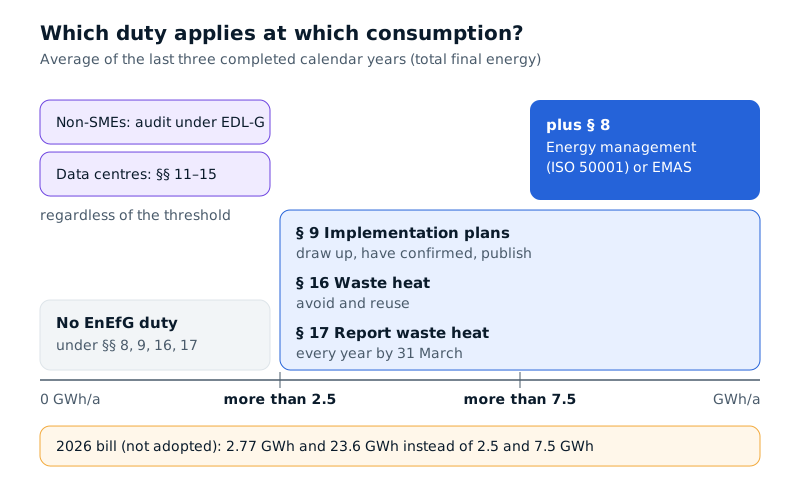 Figure 1: Duties by consumption threshold (average of the last three completed calendar years). Sources: §§ 8, 9, 16, 17 EnEfG, § 8 EDL-G [3][4][10][11][16]. Simplified.
EnEfG duties at a glance
The duties currently in force; for deadlines, the date on which a company first exceeded the threshold matters.
| Consumption (3-year average) | Duty | Legal basis | Deadline | Fine up to |
|---|---|---|---|---|
| more than 2.5 GWh/a | Draw up, have confirmed and publish implementation plans for economic measures | § 9 EnEfG | 3 years after completion of the audit or (re)certification/EMAS registration | €50,000 |
| more than 2.5 GWh/a | Avoid waste heat, reduce it to the technically unavoidable share, reuse it (where possible and reasonable) | § 16 EnEfG | ongoing | €100,000 |
| more than 2.5 GWh/a | Report waste heat data to the waste heat platform and provide information on request | § 17 EnEfG | every year by 31 March | €50,000 |
| more than 7.5 GWh/a | Energy management system (ISO 50001) or environmental management system (EMAS) with minimum content | § 8 EnEfG | 18 July 2025 (status up to 17 Nov 2023) or 20 months after reaching the threshold | €100,000 |
| Non-SMEs (regardless of consumption) | Energy audit to EN 16247-1 every 4 years; exempt with ISO 50001/EMAS | §§ 8, 8a EDL-G | 4 years from the last audit | €50,000 |
| Data centres from 300 kW | PUE limits, renewable electricity, waste heat reuse, EnMS, reporting | §§ 11–15 EnEfG | staggered 2024–2030 | €50,000–100,000 |
Table 2: Sources [3][4][6][7][10][11][12][13][15][16][17]. Fines under § 19 EnEfG and, for the EDL-G, according to BAFA.
Energy management system above 7.5 GWh (§ 8)
Who needs one, and by when
Companies with an average annual total final energy consumption of more than 7.5 GWh must set up an energy or environmental management system [3]. According to BAFA this applies to SMEs and non-SMEs alike; ISO 50001 and EMAS are recognised [13]. So there is no general ISO 50001 requirement for all companies; the ISO 50001 requirement only arises above this threshold or under other rules. In spot checks, BAFA asks for a valid certificate from an accredited body for an energy management system [13].
Deadlines under § 8(2) [3][13]:
- Companies that had reached the threshold by 17 November 2023: system in place by 18 July 2025.
- Companies reaching the threshold from 18 November 2023: within 20 months. BAFA’s example: threshold established on 1 January 2024, deadline 1 September 2025.
Until then, at most until these deadlines, they are exempt from the EDL-G audit duty (§ 8(1) EDL-G) [3].
What the system must contain at minimum
§ 8(3) goes beyond the standard and explicitly requires [3]:
- recording of energy input and output, process temperatures, waste heat media with temperatures, heat quantities and possible constituents, and of technically avoidable and unavoidable waste heat, including a check whether waste heat can be recovered and used,
- identification and documentation of technically feasible final energy saving measures and of measures for waste heat recovery and use,
- an economic assessment of these measures to EN 17463 (December 2021 edition, “Valuation of Energy Related Investments (VALERI)”) [28].
Meeting this duty across several plants, warehouses or branches needs comparable consumption data per site. Energy monitoring for EnEfG compliance brings such data together; it does not replace the management system with its responsibilities, targets and audits.
EnEfG implementation plan above 2.5 GWh (§ 9)
What an implementation plan is
Companies above 2.5 GWh must draw up and publish “concrete, feasible implementation plans” for all final energy saving measures identified as economic [4]. The measures come from a management system under § 8 EnEfG, such a system under the EDL-G, or an EDL-G energy audit [4]. According to BAFA, the duty only applies to audits completed after 18 November 2023 and to action plans drawn up after that date [13].
Important: the law requires a plan, not the implementation itself. Whether and when a company invests remains its own decision.
When a measure counts as economic
A measure is economic if an assessment to EN 17463 shows a positive net present value after no more than 50% of its useful life [4]. This only applies to measures with a useful life of up to 15 years; the useful life follows the depreciation tables of the Federal Ministry of Finance [4]. BAFA names the “most likely” scenario as the basis of the assessment [13].
Worked example (illustrative, heavily simplified): a measure costs €40,000, saves €10,000 a year and has a useful life of 10 years under the depreciation tables, so the test is whether the net present value is positive after 5 years. At an assumed discount rate of 5%, the present value factor for 5 years is about 4.33: −€40,000 + €10,000 × 4.33 ≈ +€3,300. The measure would count as economic. Assumptions: constant savings, no energy price increase, no maintenance costs, no residual value. EN 17463 considers further variables and scenarios; the real assessment belongs with experts.
Deadline, confirmation and publication
- Deadline: three years from ISO 50001 (re)certification, EMAS registration or renewal, or completion of the energy audit [4][13].
- Confirmation: before publication, certification bodies, environmental verifiers or energy auditors must confirm completeness and correctness [4], and not people who introduced or operated the system [13].
- Publication: required, but business secrets may be left out [4]; BAFA does not specify where [13].
- Checks: BAFA carries out spot checks and can request evidence within four weeks via an electronic form [5][13].
For an EnEfG implementation plan, consumption data before and after a measure helps to check the assumed savings later, for example in an energy dashboard. Confirmation by a certification body, verifier or auditor is not affected.
Waste heat: avoid, reuse, report (§§ 16, 17)
The waste heat duties apply to companies with an average annual consumption above 2.5 GWh [10][11].
§ 16, avoid and reuse: companies must avoid waste heat according to the state of the art and reduce it to the technically unavoidable share, as far as possible and reasonable (technical, economic and operational aspects count). The rest must be reused, also beyond the installation, on site or by third parties, ideally in temperature cascades [10]. § 16 does not apply to installations permitted under § 4 of the Federal Immission Control Act (BImSchG) where more specific waste heat rules apply [10].
§ 17, waste heat platform: on request, companies must tell heat network operators, district heating suppliers and other potential users the location, annual heat quantity, maximum thermal output, availability, controllability and average temperature of their waste heat [11]. The same data goes every year by 31 March to the BfEE, which publishes it on a public platform, protecting business secrets and security-relevant data [11].
Only ducted sources above the BfEE’s de minimis thresholds (heat quantity, operating hours or temperature) must be reported; diffuse sources are currently not covered, and reporting creates no duty to use the heat [14].
For industrial companies, the waste heat duties therefore need measured temperatures, heat quantities and operating times, usually from heat meters and process control systems.
Data centres: Germany’s own requirements (§§ 11–15)
Under § 3 no. 24, a data centre is a facility with a non-redundant rated electrical connection capacity of 300 kW or more [1]. Germany’s data centre requirements cover efficiency, renewable electricity, waste heat reuse and reporting. The main points for operators:
| Requirement | Existing (in operation before 1 Jul 2026) | New (in operation from 1 Jul 2026) |
|---|---|---|
| Power usage effectiveness (PUE, annual average) | ≤ 1.5 from 1 Jul 2027; ≤ 1.3 from 1 Jul 2030 | ≤ 1.2 at the latest 2 years after commissioning |
| Energy reuse factor (ERF, EN 50600-4-6) | no specific requirement in § 11 | at least 10%; if commissioned from 1 Jul 2027: 15%, from 1 Jul 2028: 20%; exceptions under § 11(3) |
| Electricity from renewable sources (on balance) | 50% from 1 Jan 2024; 100% from 1 Jan 2027 | as for existing |
| Energy or environmental management system | by 1 Jul 2025; validated/certified from 1 Jan 2026 at ≥ 1 MW (public sector: ≥ 300 kW) | as for existing |
| Information and reporting | every year by 31 March to the federal government (§ 13); energy consumption per customer from 1 Jan 2024 (§ 15) | as for existing |
Table 3: Duties for data centres under §§ 11, 12, 13 and 15 EnEfG [6][7][8][9]. Operators of IT equipment have their own thresholds (certification from 500 kW, public sector from 300 kW) [7].
Exemptions from the management system include facilities due to close before 1 July 2027 and data centres up to 7.5 GWh that feed at least half of their reused energy into a heat network [7]. Continuous measurement of the electrical power and energy demand of the main components is explicitly part of the management system [7], which makes data integration from power distribution, cooling and IT relevant; Nebatic neither supplies data centre equipment nor calculates binding PUE values.
Energy audits under the EDL-G
Separately, the Energy Services Act (EDL-G) requires energy audits from companies that are not micro, small or medium-sized enterprises under EU Recommendation 2003/361/EC [18]. BAFA describes these as having 250 or more employees, or more than €50 million turnover and more than €43 million balance sheet total, including linked and partner enterprises [15].
- Interval: at least every four years from completion of the previous audit [16].
- Requirements: compliant with EN 16247-1 (November 2022 edition), based on current, measured or traceably determined operating data on energy consumption and load profiles, using the net present value method, and covering at least 90% of total energy consumption [17][29].
- Auditors: must meet § 8b EDL-G. Listing in BAFA’s auditor register is voluntary and, according to BAFA, does not guarantee a proper audit [15].
- Exemption: companies with an energy management system or EMAS are exempt [16]. According to BAFA the system must cover at least 90% of total energy consumption [15].
- Fine: up to €50,000 [15].
Above 2.5 GWh, EDL-G audit results feed into the § 9 implementation plans [4]. Unlike the directive’s consumption-based audit duty (10 TJ) [31], the German audit duty in force is still tied to company size.
Timeline of the key deadlines
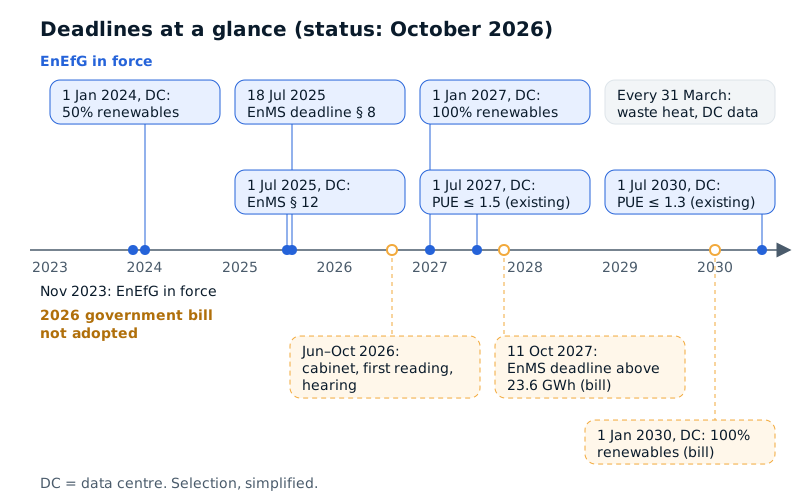 Figure 2: Selected deadlines of the EnEfG in force (top) and of the 2026 government bill that has not been adopted (bottom, dashed). Sources: [3][4][6][7][9][11][19]. Status: October 2026.
Fines and checks
§ 19 EnEfG lists nine administrative offences, intentional or negligent [12]. Fines of up to €100,000 apply if a management system is not set up, not correctly or not in time, if a data centre misses the § 11 requirements, or if waste heat is not avoided or reduced under § 16. Other offences, for example on implementation plans, their confirmation or waste heat reports, carry up to €50,000 [12]. BAFA is responsible, except for waste heat avoidance [12].
In its spot checks, BAFA writes to companies and asks for evidence via an electronic form: a valid ISO 50001 certificate, the EMAS registration, or for implementation plans the confirmation and proof of publication [13]. Companies that are not obliged must document their exemption on request [13].
Common mistakes
- Counting only electricity: transport fuels, gas and heat are part of total final energy consumption [13].
- Looking at one year only: the three-year average counts; a single outlier year neither avoids nor triggers the duty [3][4].
- Confusing the plan with an obligation to invest: § 9 requires plans, confirmation and publication, not the investment [4].
- Confirmation by your own consultant: whoever introduced the system may not confirm the plan [13].
- Treating the waste heat report as done: it must be confirmed or updated every year by 31 March [11][14].
- Treating the bill as law: until an amendment is published, the current EnEfG applies.
How measured data supports an energy management system
ISO 50001:2018 describes a management system based on the plan-do-check-act cycle; progress is shown with energy performance indicators (EnPIs) and an energy baseline (EnB) [23]. The German Environment Agency explains the building blocks: the energy review shows energy sources and quantities and identifies significant energy uses (SEUs); the baseline is the reference for later improvements; EnPIs account for factors such as production volume or weather; monitoring relies on main meters and sub-meters [27]. A German ministry and agency guide describes a practical route from energy audit to ISO 50001 [26].
Two standards cover the data side in more depth: ISO 50006:2023 gives guidance on EnPIs, baselines and monitoring energy performance [24]; ISO 50015:2014 sets out principles for measuring and verifying energy performance [25].
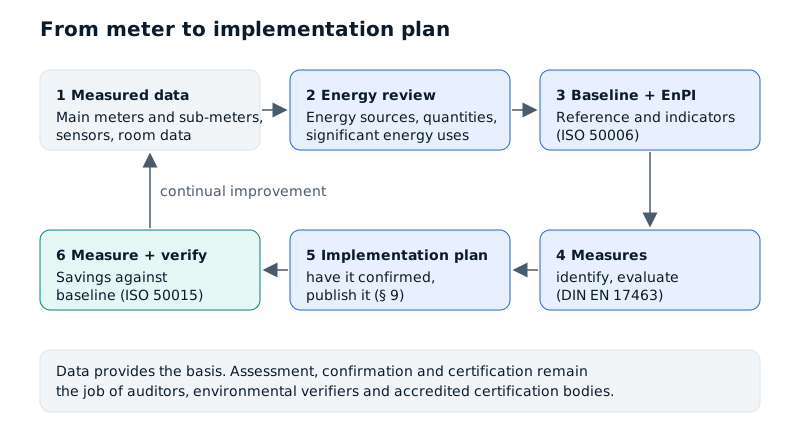 Figure 3: How measured data flows through an energy management system. Own illustration based on ISO 50001, ISO 50006, ISO 50015 and UBA [23][24][25][27].
Recording consumption over time and per site, plant or part of a building makes it easier to determine thresholds, identify significant energy uses, compare savings with the baseline and assemble evidence for auditors and certification bodies.
How Nebatic helps
Nebatic provides data and monitoring, not legal advice and not certification. Existing meters, sensors and building systems can be connected through API and integration and brought together in an energy dashboard or multi-site monitoring; the data can also flow into CAFM, BI or ESG tools. Nebatic’s own devices record room data such as CO₂, temperature and humidity, which helps to relate consumption to use and indoor climate, for example for ventilation or heating in offices.
In the Audit & analysis service, Nebatic measures over an agreed period and analyses the data with recommendations, for example before and after a measure. For larger property portfolios near the 7.5 GWh threshold, see owners and operators. Energy audits, confirmation of implementation plans and certification remain the job of energy auditors, environmental verifiers and accredited certification bodies.
Status of the amendment (October 2026)
The federal government adopted the “Draft act to accelerate the transposition of the Energy Efficiency Directive” (Entwurf eines Gesetzes zur Beschleunigung der Umsetzung der Energieeffizienzrichtlinie) and sent it to the Bundesrat on 25 June 2026 (BR-Drs. 388/26) [19]. It is meant to transpose directive (EU) 2023/1791 and to roll back national requirements that go beyond EU law [19][20]. The Bundestag held the first reading of the bill (BT-Drs. 21/8027) on 24 September 2026; the Committee on Economic Affairs and Energy heard experts on 5 October 2026 [20][21]. There had been no final vote by mid-October 2026; the bill has not been adopted [20][21].
According to the bill, the changes include [19]:
- EnMS/EMS duty only above 23.6 GWh (instead of 7.5 GWh), with a deadline of 11 October 2027 for companies with that status by the end of 2025,
- energy audits under the EDL-G for companies from 2.77 GWh, at least every four years,
- implementation plans for companies between 2.77 and 23.6 GWh within three months of the audit, to be updated every year,
- waste heat reporting only for companies above 23.6 GWh and data centres above 1 MW,
- for data centres: a definition from 500 kW of installed IT capacity, PUE ≤ 1.6 (from 1 July 2027) or ≤ 1.4 (from 1 July 2030) for existing facilities, four instead of two years for new facilities to meet the efficiency values, and 100% renewable electricity only from 1 January 2030.
These figures sit close to the directive’s 85 TJ and 10 TJ (about 23.6 and 2.8 GWh, see above). Whether and in what form they become law is open. Until then, the duties described above apply.
Limits and risks
- Legal assessment: whether a company is obliged depends on the legal definition of the company, group structures and exemptions; ask specialist energy lawyers or BAFA.
- Technical assessment: EN 17463 assessments, energy audits and waste heat concepts belong with energy consultants and auditors; confirmations and certificates with environmental verifiers and accredited certification bodies.
- Measured data: data makes consumption visible but replaces neither calibrated billing meters nor management system documentation; missing sub-meters or gaps lead to unreliable indicators.
- Funding: whether measures can be funded is for BAFA, KfW or an energy consultant to clarify.
- Legal status: the bill may change during the legislative process. Deadlines and thresholds should be checked against the current legal text before decisions are made.
Frequently asked questions
What is the German Energy Efficiency Act (EnEfG)?
The Act to Increase Energy Efficiency in Germany of November 2023 [1]. It sets national targets and consumption-based company duties: implementation plans and waste heat duties above 2.5 GWh, an energy or environmental management system above 7.5 GWh, and separate data centre rules [3][4][6][10][11].
Is ISO 50001 mandatory in Germany?
Not in general. The EnEfG requires an energy or environmental management system above 7.5 GWh; EMAS is an equivalent alternative [3][13]. Data centres have their own rules under § 12 [7]. Under the EU directive, the threshold for an energy management system is 85 TJ [31].
What must an EnEfG implementation plan contain?
Concrete, feasible plans for all measures that count as economic under EN 17463, meaning a positive net present value after at most half of the useful life (for useful lives of up to 15 years). Before publication the plan must be confirmed by a certification body, environmental verifier or energy auditor [4][13].
Who has to carry out an energy audit in Germany?
Under the EDL-G, all non-SMEs, every four years to EN 16247-1, unless exempt through an energy management system or EMAS [15][16][17]. The EU directive sets a consumption-based threshold of 10 TJ instead [31].
What are Germany’s data centre requirements?
A data centre under the EnEfG has a non-redundant rated electrical connection capacity of 300 kW or more [1]; duties cover PUE limits, renewable electricity, waste heat reuse for new facilities, a management system and reporting [6][7][8][9]. The 2026 bill, not adopted, would switch to 500 kW of installed IT capacity [19].
Will the thresholds be raised?
A government bill provides for 23.6 GWh for the management system and 2.77 GWh for audits and implementation plans. As of October 2026 the Bundestag is still debating it; until an amendment is published, the current law applies [19][20][21].
Sources
- Federal Office of Justice (2023): Gesetz zur Steigerung der Energieeffizienz in Deutschland (Energieeffizienzgesetz – EnEfG), BGBl. 2023 I No. 309, incl. § 1 and § 3. https://www.gesetze-im-internet.de/enefg/BJNR1350B0023.html
- Federal Office of Justice: § 4 EnEfG (energy efficiency targets). https://www.gesetze-im-internet.de/enefg/__4.html
- Federal Office of Justice: § 8 EnEfG (energy or environmental management systems). https://www.gesetze-im-internet.de/enefg/__8.html
- Federal Office of Justice: § 9 EnEfG (implementation plans). https://www.gesetze-im-internet.de/enefg/__9.html
- Federal Office of Justice: § 10 EnEfG (spot checks). https://www.gesetze-im-internet.de/enefg/__10.html
- Federal Office of Justice: § 11 EnEfG (climate-neutral data centres). https://www.gesetze-im-internet.de/enefg/__11.html
- Federal Office of Justice: § 12 EnEfG (energy and environmental management systems in data centres). https://www.gesetze-im-internet.de/enefg/__12.html
- Federal Office of Justice: § 13 EnEfG (information duties of data centres). https://www.gesetze-im-internet.de/enefg/__13.html
- Federal Office of Justice: § 15 EnEfG (information to customers). https://www.gesetze-im-internet.de/enefg/__15.html
- Federal Office of Justice: § 16 EnEfG (avoidance and use of waste heat). https://www.gesetze-im-internet.de/enefg/__16.html
- Federal Office of Justice: § 17 EnEfG (waste heat platform). https://www.gesetze-im-internet.de/enefg/__17.html
- Federal Office of Justice: § 19 EnEfG (provisions on fines). https://www.gesetze-im-internet.de/enefg/__19.html
- Federal Office for Economic Affairs and Export Control (BAFA) (2024): Merkblatt für das Energieeffizienzgesetz (EnEfG) [guidance note on the EnEfG], version 1.2, 1 March 2024. https://www.bafa.de/SharedDocs/Downloads/DE/Energie/ea_merkblatt_energieefffizienzgesetz.html
- Federal Office for Energy Efficiency (BfEE) at BAFA: Plattform für Abwärme [waste heat platform]. https://www.bfee-online.de/BfEE/DE/Effizienzpolitik/Plattform_fuer_Abwaerme/plattform_fuer_abwaerme_node.html
- Federal Office for Economic Affairs and Export Control (BAFA): Energieaudit [energy audit]. https://www.bafa.de/DE/Energie/Energieeffizienz/Energieaudit/energieaudit_node.html
- Federal Office of Justice: § 8 EDL-G (energy audits). https://www.gesetze-im-internet.de/edl-g/__8.html
- Federal Office of Justice: § 8a EDL-G (requirements for energy audits). https://www.gesetze-im-internet.de/edl-g/__8a.html
- Federal Office of Justice: § 1 EDL-G (scope). https://www.gesetze-im-internet.de/edl-g/__1.html
- Bundesrat (2026): Government bill – Entwurf eines Gesetzes zur Beschleunigung der Umsetzung der Energieeffizienzrichtlinie, printed paper 388/26 of 25 June 2026. https://dserver.bundestag.de/brd/2026/0388-26.pdf
- German Bundestag (2026): First reading on transposing the Energy Efficiency Directive (printed paper 21/8027), 24 September 2026. https://www.bundestag.de/dokumente/textarchiv/2026/kw39-de-energieeffizienzrichtlinie-1211306
- German Bundestag (2026): Public hearing of the Committee on Economic Affairs and Energy on the Energy Efficiency Directive, 5 October 2026. https://www.bundestag.de/dokumente/textarchiv/2026/kw41-pa-wirtschaft-energieeffizienzrichtlinie-1218082
- European Union (2023): Directive (EU) 2023/1791 of the European Parliament and of the Council of 13 September 2023 on energy efficiency. https://eur-lex.europa.eu/eli/dir/2023/1791/oj
- ISO (2018): ISO 50001:2018 – Energy management systems – Requirements with guidance for use. https://www.iso.org/standard/69426.html
- ISO (2023): ISO 50006:2023 – Energy management systems – Evaluating energy performance using energy performance indicators and energy baselines. https://www.iso.org/standard/79367.html
- ISO (2014): ISO 50015:2014 – Energy management systems – Measurement and verification of energy performance of organizations – General principles and guidance. https://www.iso.org/standard/60043.html
- BMU/Umweltbundesamt (2019): Energiemanagementsysteme in der Praxis – Vom Energieaudit zum Managementsystem nach ISO 50001 [Energy management systems in practice], 2nd edition. https://www.umweltbundesamt.de/publikationen/energiemanagementsysteme-in-praxis
- Umweltbundesamt (2021): Energiemanagementsysteme: ISO 50005 [Energy management systems: ISO 50005]. https://www.umweltbundesamt.de/energiemanagementsysteme-iso-50005
- DIN Media: DIN EN 17463:2021-12 – Valuation of Energy Related Investments (VALERI). https://www.dinmedia.de/de/norm/din-en-17463/338018270
- DIN Media: DIN EN 16247-1:2022-11 – Energy audits – Part 1: General requirements. https://www.dinmedia.de/de/norm/din-en-16247-1/352350790
- European Commission, Directorate-General for Energy: Energy Efficiency Directive. https://energy.ec.europa.eu/topics/energy-efficiency/energy-efficiency-targets-directive-and-rules/energy-efficiency-directive_en
- European Commission (2024): Commission Recommendation (EU) 2024/2002 of 24 July 2024 setting out guidelines for the interpretation of Article 11 of Directive (EU) 2023/1791 as regards energy management systems and energy audits. https://eur-lex.europa.eu/eli/reco/2024/2002/oj/eng