This article draws on UK and German guidance. Values and rules differ by country (status: November 2026).
In short
- A thermal bridge (also called a cold bridge) is a part of the building envelope where heat escapes faster than through the surrounding construction. The inside surface there is colder: in external corners, window reveals, at floor and balcony slabs, around lintels and roller shutter boxes.
- Mould does not need visible condensation. It can start when the relative humidity at a surface reaches about 80% for several days [1][2].
- Designers use the surface temperature factor fRsi to judge junctions. UK guidance (BRE IP1/06) recommends at least 0.75 for dwellings and 0.5 for offices and retail [1]; the German standard DIN 4108-2 sets 0.70, which corresponds to 12.6 °C under standard conditions [3].
- Whether a thermal bridge leads to mould depends on the junction and on how the room is used: temperature, humidity and furniture placement.
- Long-term room data separates the two causes, which matters for landlords, tenants and surveyors alike.
The symptom: mould that always comes back in the same place
The black spots return every winter in the same spots: the top corner of a bedroom on the north side, behind a wardrobe on an external wall, along the head of a window. They are cleaned, painted over and reappear. In commercial buildings the pattern is similar in storerooms, archives and rarely heated rooms.
The recurring question is whether the building or its use is to blame. Usually it is both. A thermal bridge creates a cold surface; indoor humidity and heating decide whether that surface becomes damp enough for mould.
Why thermal bridges cause condensation and mould
Warm air holds more water vapour than cold air. When room air meets a cold surface, it cools and its relative humidity rises. An example from the Bavarian State Office for the Environment: air at 20 °C and 55% relative humidity reaches about 80% when cooled to 14 °C, and below 11 °C water condenses [2].
| Type | What happens | Typical locations |
|---|---|---|
| Geometric thermal bridge | A small warm inner surface faces a large cold outer surface | External corners, wall–roof edges |
| Repeating or constructional thermal bridge | A material conducts heat better than its surroundings | Concrete floor and balcony slabs, steel beams, lintels, window frames, wall ties |
| Junction thermal bridge | Insulation layers do not meet | Window installation, wall–floor junctions, eaves |
Table 1: Types of thermal bridges. Own compilation.
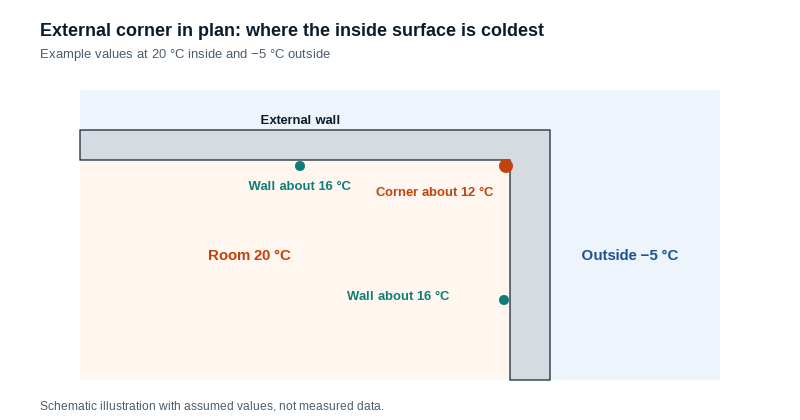
Figure 1: Inside surface temperature at an external corner compared with a plain wall. Schematic illustration, not measured data.
Furniture makes things worse: a wardrobe against an external wall keeps warm room air away from the surface behind it, which becomes colder [3].
Worked example: when does a surface become critical?
Worked example (own calculation with the Magnus formula): for a room at 20 °C (68 °F), the surface temperature at which surface humidity reaches 80% depends on room humidity:
| Room humidity at 20 °C | Dew point | Surface reaches 80% RH at |
|---|---|---|
| 40% | 6.0 °C (43 °F) | 9.3 °C (49 °F) |
| 50% | 9.3 °C (49 °F) | 12.6 °C (55 °F) |
| 60% | 12.0 °C (54 °F) | 15.4 °C (60 °F) |
| 65% | 13.2 °C (56 °F) | 16.7 °C (62 °F) |
Table 2: Critical surface temperatures at 20 °C room air. Own calculation.
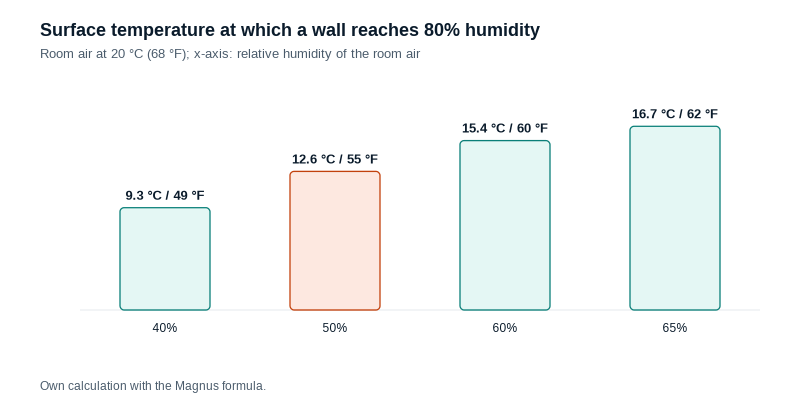
Figure 2: Critical surface temperature against room humidity. Own calculation.
The table explains the German 12.6 °C value: it is the 80% point at 20 °C and 50% room humidity. If room humidity rises to 60%, a surface at 15 °C is already at risk. A junction that is harmless in a well-ventilated room can grow mould in a crowded or poorly ventilated one.
The surface temperature factor fRsi
fRsi compares the temperature drop across the building fabric with the total temperature drop between inside and outside air; because it is a ratio, it can be used under any weather conditions [1]. A value of 1 would mean the inside surface is as warm as the room; a value of 0 that it is as cold as outside.
| Guidance | Building use | Minimum fRsi |
|---|---|---|
| BRE IP1/06 (UK) | Dwellings | 0.75 [1] |
| BRE IP1/06 (UK) | Offices and retail | 0.5 [1] |
| BRE IP1/06 (UK) | Swimming pools, very humid rooms | 0.9 [1] |
| DIN 4108-2 (Germany) | Heated rooms | 0.70, about 12.6 °C [3] |
Table 3: Minimum surface temperature factors. Status November 2026.
How to find thermal bridges
| Method | What it shows | Limits |
|---|---|---|
| Visual inspection | Staining, mould, peeling paint | Shows damage, not the cause |
| Infrared thermometer | Spot surface temperature | One moment, depends on weather and heating |
| Thermal imaging | Cold areas and air leaks across a surface | Needs a large inside–outside temperature difference; interpretation by specialists |
| Thermal bridge modelling | fRsi and heat loss of a junction (psi value) | Design tool, does not reflect use |
| Long-term monitoring | Room temperature and humidity over weeks, day and night | Needs sensors and analysis |
Table 4: Ways to find and assess thermal bridges.
A single winter check shows whether a spot is cold. Whether it will grow mould depends on how often, and for how long, surface temperature and room humidity sit in a critical range.
Fixing the problem
- Fabric: external wall insulation removes most thermal bridges because the whole wall becomes warmer. Single junctions (lintels, window installation, shutter boxes) can be improved. Internal insulation needs careful design, or it can create new cold spots [3].
- Room conditions: lower indoor humidity through regular ventilation and steady heating; avoid letting rooms on external walls cool down sharply.
- Furniture: keep wardrobes and shelves a few centimetres away from external walls.
- Follow-up: after any work, check that the critical spots stay dry over a full heating season.
How Nebatic helps
Nebatic measures temperature and humidity continuously, room by room. The histories show when and where humidity rises, whether rooms cool down at night and whether ventilation and heating work. Combined with surface checks at the critical spot, this shows whether the junction or the room conditions are the main cause. See finding the cause of mould and preventing mould by monitoring humidity.
Nebatic does not replace a survey or a building investigation. It provides data that surveyors, landlords and occupants can use to settle the cause objectively.
Risks and limits
- Medical advice: if occupants have complaints that may be linked to damp or mould, they should see a doctor. Larger mould growth should be removed by a specialist company.
- Specialist work: thermal imaging, thermal bridge modelling and remedial design need building physicists or surveyors.
- Responsibility: in rented homes, the split between building and use is often disputed. Data supports an objective discussion but does not replace a legal assessment. General information, not legal advice.
Further reading: mould in a flat: finding the cause with data, not guesswork.
Thermal bridges: quick answers
What is a thermal bridge?
A part of the building envelope where more heat escapes than through the construction around it, so the inside surface is colder. Typical examples are external corners, window reveals and concrete balcony slabs.
What is the difference between a thermal bridge and a cold bridge?
None. “Cold bridge” is the everyday term, “thermal bridge” the technical one.
What fRsi value prevents mould?
UK guidance (BRE IP1/06) recommends at least 0.75 for dwellings and 0.5 for offices and retail [1]. Germany uses 0.70 [3]. Higher indoor humidity needs a higher value.
Can mould grow without condensation?
Yes. Mould can start at around 80% relative humidity at the surface over several days, before water droplets are visible [1][2].
Does ventilation solve thermal bridge mould?
It lowers indoor humidity and therefore the risk. The cold spot itself remains; a lasting fix needs work on the building fabric.
Sources
- Schöck UK: The surface temperature factor fRsi (summarising BRE IP1/06). https://www.schoeck.com/en-gb/press/the-surface-temperature-factor-frsi
- Bavarian State Office for the Environment (LfU), Ökoenergie-Institut Bayern (2016): Physical background of mould (German). https://www.energieatlas.bayern.de/sites/default/files/Physikalische_Hintergruende_Schimmel.pdf
- BauNetz Wissen: Thermal protection – surface temperature (DIN 4108-2, German). https://www.baunetzwissen.de/fassade/fachwissen/bauphysik/waermeschutz-oberflaechentemperatur-154555