Many sources are German; the building physics is the same everywhere, but standards and landlord duties differ by country. General information, not legal or medical advice (status: October 2026).
Key points
- Mould in a flat has a cause, and it has to be found before any remediation. Germany’s Federal Environment Agency (Umweltbundesamt, UBA) and the German medical guideline on indoor mould exposure agree: first find and stop the moisture source, then remove the mould, or it comes back [4][6][12].
- Damp and mould are common. According to EU-SILC, around 16% of people in Germany lived in 2023 in a dwelling with a leaking roof, damp walls, floors or foundation, or rot in window frames or floors; the EU figure was 15.5% [1][2]. An inspection of 5,530 German homes found visible damp damage in 21.9% and mould in 9.3% [3].
- What matters is humidity at the surface, not in the room air. Mould can grow at 70 to 80% relative humidity on a surface if this lasts for some time; condensation is not needed [4]. Cold spots such as external wall corners and thermal bridges reach these values first.
- Data can tell causes apart. Moisture from daily life, thermal bridges, leaks and drying-out moisture leave different patterns in humidity and temperature over weeks; a single hygrometer reading does not.
- Room data does not replace experts. It gives landlords, residents and surveyors a factual basis; building defects are assessed by a qualified surveyor, health complaints belong with a doctor.
Damp and mould in flats: how common is it?
Anyone who manages flats knows the situation: a tenant reports dark spots in the bedroom corner, the caretaker suspects “not enough airing”, the tenant suspects “cold walls”. Both are possible, and the stain rarely tells you which is right. This is where the question of the causes of mould in a flat begins, and the answer decides whether a repair lasts. (For US readers: the same applies to mold in an apartment.)
EU statistics on income and living conditions (EU-SILC) show how widespread damp is. For Germany, Eurostat reports that in 2023 16.0% of the population lived in a dwelling with a leaking roof, damp walls, floors or foundation, or rot in window frames or floors, up from 12.0% in 2019 [1]. Eurostat flags the 2023 value as of low reliability, and the indicator combines several types of damage, not mould alone. For the EU as a whole Eurostat gives 15.5% for 2023 [2]. Among people with an income below the at-risk-of-poverty threshold, the German figure for 2023 was 20.3% [1].
More detailed but older data come from a nationwide German inspection study. In 5,530 randomly selected homes, 21.9% had visible damp damage and 9.3% had mould [3]. A separate analysis for North Rhine-Westphalia (909 homes, inspected by district master chimney sweeps) found 21.2% and 8.0% [3]. The survey dates from the early 2000s and the building stock has changed since, but the order of magnitude shows that in large portfolios damp and mould regularly affect individual flats.
Why it matters for health and for the building
The UBA mould guideline (2017, clarified in April 2024) [4][5] states that people in damp or mould-affected indoor spaces have an increased risk of various respiratory diseases and regards a link with the development of asthma, especially in children, as established [4]. The World Health Organization names increased respiratory symptoms, allergies and asthma as the most important effects and recommends preventing or minimising persistent dampness and microbial growth on interior surfaces [7].
The German medical guideline on indoor mould exposure (AWMF register no. 161/001, 2023 update) lists conditions with sufficient evidence of an association, including asthma, allergic rhinitis and bronchitis, and names risk groups such as people with immunosuppression, cystic fibrosis or asthma [6]. Its first key statement is that mould growth of relevant extent indoors should not be tolerated as a precaution [6]. These findings allow no conclusions about individuals. Anyone with symptoms should see a doctor; the UBA also refers to environmental medicine advice centres [8][11].
For the building, persistent damp means damaged materials, repair costs and, in rented homes, disputes. The UBA points out that mould in a rented flat counts as a defect under German tenancy law [8], one more reason to establish the cause in a traceable way.
Why mould grows: humidity, dew point and cold surfaces
Mould spores are present in every home; growth only happens when they land on a damp surface [11]. So the key question is not “how humid is the air?” but “how damp is it right at the wall?”.
Relative humidity depends on temperature
Warmer air can hold more water vapour. Relative humidity states what percentage of that maximum it contains. If the same air cools, for instance at a cold external wall, its relative humidity rises although no water is added. At 100% the dew point is reached and water condenses. With room air at 20 °C and 50% relative humidity, the dew point is about 9.3 °C [14].
Mould does not need condensation
According to the UBA mould guideline, 70 to 80% relative humidity at a material surface is enough for mould if it persists; the lower limit under otherwise optimal conditions is about 70% [4]. That is the short answer to what humidity causes mould: it is the humidity at the surface that counts. A Bavarian Ministry of Economic Affairs leaflet puts it this way: mould can form if relative humidity at the component surface is above 80% for at least twelve hours a day on at least five consecutive days; at higher humidity shorter periods are enough [14]. Damage often starts well above the dew point, where no water is visible.
Thermal bridges and the minimum surface temperature
A thermal bridge is an area where heat escapes faster than through the surrounding surface: external wall corners (geometric), concrete floor slabs and balconies that cut through the insulation (structural), or workmanship defects [14]. On the inside, the surface there is colder. The German minimum thermal insulation standard DIN 4108-2 therefore requires a temperature factor fRsi of at least 0.70 at such points [15]. With boundary conditions of 20 °C inside and −5 °C outside, this gives a minimum interior surface temperature of about 12.6 °C [15][16]. With room air at 20 °C and 50% relative humidity, that roughly matches the point at which the surface reaches 80% relative humidity [14][16].
Two lessons follow. A detail that meets the standard is only designed for certain conditions; if room humidity stays higher, it can still become critical. And a genuine thermal bridge can cause mould even with normal use. Whether it is thermal bridge mould or occupant moisture depends on the relationship between room humidity and surface temperature.
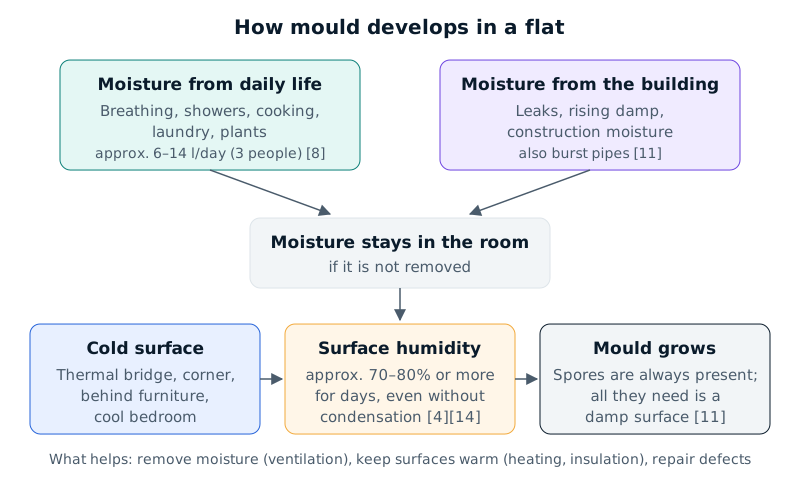 Figure 1: How mould develops: not the room air alone, but humidity at a cold surface over time is decisive. Sources: UBA mould guideline [4], UBA [11], Bavarian Ministry of Economic Affairs [14].
Worked example (illustrative): how room humidity and surface temperature interact
Assumptions: room air at 20 °C. Three points on a wall with different surface temperatures: 17.5 °C (the surface of a reasonably insulated external wall, assumed value), 12.5 °C (a corner that just meets the fRsi = 0.70 criterion at −5 °C outside: −5 + 0.70 × 25 = 12.5 °C) and 10 °C (a pronounced thermal bridge, assumed value). Relative humidity at the surface was calculated with the Magnus approximation for saturation vapour pressure; heat storage, furniture and air movement are ignored.
| Room air (20 °C) | Surface 17.5 °C | Surface 12.5 °C | Surface 10 °C |
|---|---|---|---|
| 40% relative humidity | approx. 47% | approx. 64% | approx. 76% |
| 50% relative humidity | approx. 58% | approx. 81% | approx. 95% |
| 60% relative humidity | approx. 70% | approx. 97% | condensation (100%) |
Worked example, own calculation with the stated assumptions; not measured values.
The same room air can be harmless in the middle of the wall and critical in the corner, and ten percentage points more room humidity at a cold spot can make the difference between “no problem” and “condensation”.
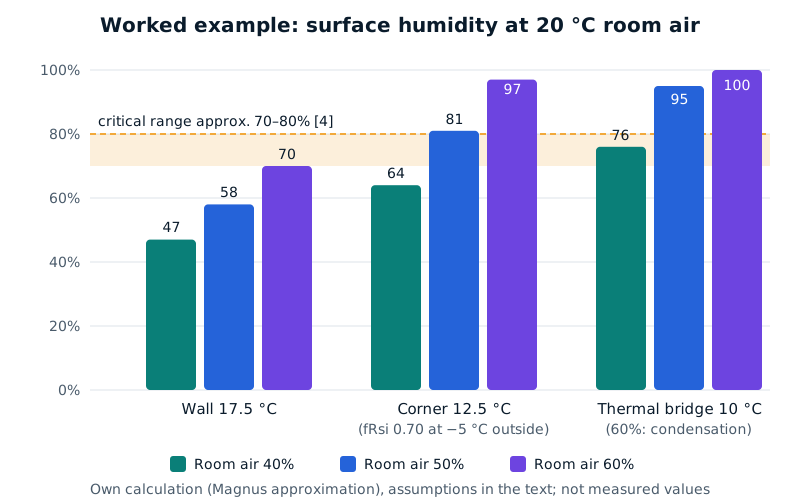 Figure 2: Worked example: calculated relative humidity at the surface with room air at 20 °C. Own calculation (Magnus approximation); 70–80% threshold from the UBA mould guideline [4].
Why corners, the backs of wardrobes and bedrooms are hit first
Mould in corners is no accident: external wall corners are geometric thermal bridges, where a small warm inner surface faces a large cold outer one. In the North Rhine-Westphalia analysis, external wall corners or edges were a separate risk factor for damp damage [3]. Behind large furniture on external walls little warm air circulates and the wall stays colder; the UBA names spots “behind cupboards” as at risk and recommends a gap of about 10 cm [8][9].
Bedrooms are often kept cooler, and according to the UBA each person releases about a quarter of a litre of water into the air per night [10]. The UBA recommends not letting the bedroom temperature drop below 16 °C if possible, unless the windows are open all night [10].
Where the moisture comes from
In its guide “Mould in the home”, the UBA gives about 6 to 14 kg of water per day, or roughly 6 to 14 litres, released as water vapour in a three-person household; per person it is 30 to 100 g per hour [8]. On top of this come showers, cooking, plants, aquariums and above all drying laundry indoors [8]. The Bavarian leaflet puts laundry drying alone in a four-person household at up to about 10 litres a day [14].
This moisture has to leave the flat through windows or a ventilation system. When windows become more airtight in an energy retrofit, part of the uncontrolled air exchange disappears; the UBA points out that more ventilation is then needed [13].
Mould in a flat: causes at a glance
The UBA lists moisture from outside (defective roofs, cracked masonry, rising damp), construction moisture that has not dried out, burst pipes and other water damage, and, inside, too little ventilation and condensation on cold walls due to thermal bridges, poor insulation or inadequate heating [11]. The German inspection study found links both with occupant behaviour (high moisture load, too little window ventilation) and with building features (leaky windows, missing insulation, external wall corners) [3]. In practice several causes often act together.
UK government guidance for rented housing uses four familiar categories: condensation damp, where moisture generated inside the home cools and condenses onto colder parts of the building (the most common form); penetrating damp from outside through defects in walls, roofs, windows or floors; rising damp, moisture from the ground rising through parts of the building in contact with it, usually in older properties and often misdiagnosed; and traumatic damp from leaking water, for example from waste or heating pipes, burst pipes or flooding [20]. The classic diagnostic question is condensation vs rising damp, and room measurements help to tell the two apart. The same guidance states that it is “totally unreasonable” to blame damp and mould on “lifestyle choices” and that landlords should identify and tackle the underlying causes [20].
The table groups the causes and their typical traces in data, as a guide for analysis, not as diagnostic criteria.
| Group | Cause | Typical pattern in data over weeks | Who decides in the end? |
|---|---|---|---|
| Ventilation and heating | High moisture load, little airing, rooms barely or not heated | Clear peaks after showers, cooking, laundry and at night in the bedroom; slow decline; low temperature in affected rooms | Talk with residents, advice if needed |
| Building | Thermal bridge (corner, floor slab, window reveal) | Room humidity normal, damage confined to one spot; risk rises in cold weather; surface much colder than room air (measured separately) | Surveyor, building physics |
| Building | Leak (roof, façade, pipe): penetrating or traumatic damp | Humidity rises regardless of use, often after rain or with no rhythm; damage grows despite good ventilation | Surveyor, specialist contractor |
| Building | Rising damp (basement, ground floor) | Permanently raised humidity near the ground, little daily rhythm; damage at the base of walls | Surveyor |
| Building | Drying-out moisture after building work (screed, plaster) | Raised baseline falling slowly over weeks to months; several rooms at once | Site management, surveyor |
| Systems | Ventilation system wrongly set, faulty or off | Humidity rises after system changes or in certain operating phases; differences between rooms | Ventilation contractor |
Table: causes based on UBA [11], Brasche/Bischof [3] and UK government guidance [20]; data patterns as a guide for analysis, not a substitute for a survey.
Finding the cause: what weeks of data show
The UBA guide says the first step is to check whether there is a source of mould and what it goes back to, such as building defects or occupant behaviour, starting with a site inspection and written record [8]. Room data adds time to that inspection.
Why a single hygrometer reading misleads
The UBA recommends simple hygrometers for orientation [8][9]. To find the cause, though, a snapshot is rarely enough:
- Timing sets the value. Humidity after a shower is much higher than after airing; a morning reading says little about the night in the bedroom.
- Duration is decisive. Mould needs raised surface humidity over time [4][14]; only a time series shows whether a peak clears in an hour or lasts for days.
- Room air is not the wall. A hygrometer measures the room, not the cold corner; the risk only becomes clear with the surface temperature (see the worked example).
- Weather changes everything. The same flat can be fine in mild weather and critical in a week of frost, when external wall surfaces cool down.
Three questions a data series can answer
1. How does humidity move through the day? Recurring peaks after morning and evening routines that clear quickly after airing point to occupant moisture that is being removed. Peaks that linger, or a permanently high baseline, show that it is not: too little ventilation, a ventilation system that is not working, or moisture from the building fabric.
2. How do the rooms differ? If only the cool bedroom stands out while living room and kitchen look normal, that room’s temperature and use come into focus. If humidity rises in several rooms at once without any change in use, a cause in the building or its systems is more likely.
3. How does the pattern relate to the weather? Risk rising mainly in cold spells points to thermal bridges; humidity rising after rain suggests checking for a leak; a baseline falling slowly over weeks may be drying-out moisture after renovation.
A data series should cover several weeks, ideally including a cold spell, in affected and, for comparison, unaffected rooms, with notes on use (airing, laundry, absences). The surface temperature at the affected spot is measured separately, for example by a surveyor with a surface probe or thermal imaging; a Berlin district authority shows such images as examples of minimum surface temperatures being undercut [16]. UK government guidance likewise names consistently high relative humidity, assessed with a moisture meter or environmental monitors, as a sign of a possible cause, and describes smart sensors as a useful aid that should supplement other procedures rather than replace them [20].
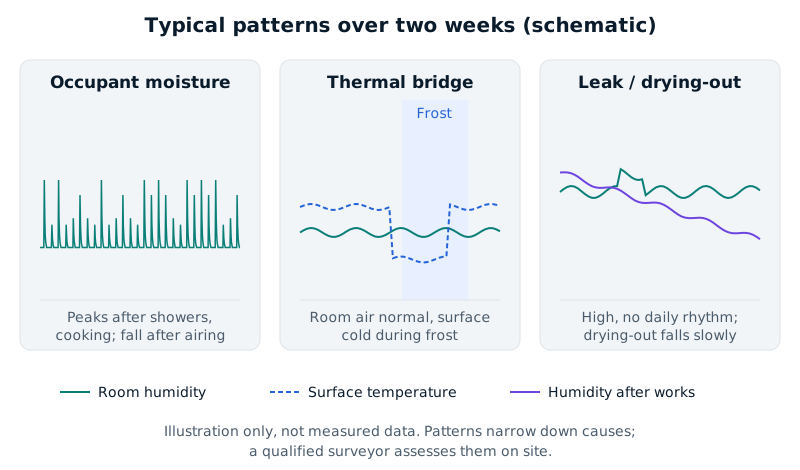 Figure 3: Schematic patterns in data series; an illustration, not measured data. Own illustration.
Ideal indoor humidity, ventilation and heating: what helps
When is indoor humidity too high?
The UBA recommends keeping relative humidity in the room air between 40 and 60% [9]. This range is a guide to ideal indoor humidity, not a limit value: at a pronounced thermal bridge even the top of the range can be too much, while a well-insulated wall tolerates higher values briefly. Humidity above this range for days is a reason to look for the cause, not the cause itself.
Short, wide-open airing instead of tilted windows
For the cold season the UBA recommends airing each room two to three times a day for about five minutes with windows wide open, depending on temperature and wind; in summer about 10 to 20 minutes; in the bedroom 5 to 10 minutes after getting up [9]. Ideally several windows are opened wide at the same time for a short period (purge ventilation); windows left permanently tilted raise energy use and heating costs considerably [9] and, according to the Bavarian leaflet, cool down window reveals and lintels [14]. Laundry should not be dried in the flat if possible [9].
Heat evenly
Rooms that are rarely used should still be heated a little; when room humidity is raised, the temperature should only be lowered after sufficient airing [10]. Radiators should be kept clear, not covered by casings, wide window sills or curtains [10].
What the measures do, and where they stop
| Measure | Acts on | Evidence | Limit |
|---|---|---|---|
| Short, wide-open airing 2–3× a day (winter) | Room humidity | UBA [9] | Does not fix leaks or rising damp |
| Room humidity 40–60% | Surface humidity on ordinary walls | UBA [9] | May not be enough at strong thermal bridges |
| Do not let rooms cool down; bedroom ≥ 16 °C if possible | Surface temperature | UBA [10] | Higher heating demand; no substitute for insulation |
| About 10 cm gap between furniture and external wall | Surface temperature behind furniture | UBA [8] | Only helps once existing mould has been removed [8] |
| Fix the thermal bridge, insulate | Surface temperature | DIN 4108-2 [15], UBA [13] | Needs professional design; adjust ventilation afterwards [13] |
| Seal leaks, dry out water damage | Moisture from the building fabric | UBA [11][13] | Drying by a specialist contractor with a measurement record [13] |
Ventilation therefore prevents mould where the moisture comes from daily life. If the cause lies in the building, more airing at best shifts the problem and costs heating energy.
Landlord responsibility for mould: data as a neutral basis
General information, not legal advice (status: October 2026). Rules differ by country; the examples below are pointers, not a complete overview.
- Germany: the landlord must keep the flat in a condition suitable for the contractual use (§ 535 Civil Code, Bürgerliches Gesetzbuch, BGB) [17]; defects can lead to a rent reduction (§ 536 BGB) [18]. The UBA calls mould in a rented flat a defect, recommends fixing damage quickly and by agreement, and refers legal questions to tenants’ and landlords’ associations [8][13]; in several federal states housing supervision authorities also advise [13].
- England: since 27 October 2025, Awaab’s Law (the Hazards in Social Housing (Prescribed Requirements) (England) Regulations 2025) sets fixed timescales for social landlords; its first phase covers damp and mould hazards that present a significant risk of harm to tenants, and all emergency hazards [21].
- Elsewhere: tenant advice services, landlord associations, local housing authorities and lawyers are the right contacts.
Data does something different: it replaces assumptions with traceable records. Instead of “you don’t air enough” against “the wall is too cold”, weeks of humidity and temperature curves per room are on the table for property manager, residents, owner and surveyor to look at together. That calms discussions and helps to bring in the right experts. How this works in residential buildings, where questions of landlord responsibility for mould are often the trigger, is described on the residential page.
Data protection matters: humidity and temperature curves in an occupied flat can reveal presence and habits. Measure in homes only with the residents’ consent and clear agreement on purpose, duration, access and deletion; in the EU the General Data Protection Regulation applies [19]. UK guidance adds that smart sensors should not be misused to blame tenants and should only be installed with their consent and understanding [20].
How Nebatic helps
Nebatic measures temperature and relative humidity per room over a longer period. In the Audit & analysis service, measurements run for an agreed period and are then analysed, with recommendations on which causes the data points to and which experts to involve next (see the page on finding the cause of mould linked above). The devices measure room air, not the wall surface, so the surface temperature at the affected spot has to be recorded separately. Existing sensors or building systems can be connected.
For prevention, the platform shows live values, trends, anomalies and notes per room. Besides temperature and humidity, the Nebatic devices also record CO₂, which can indicate how much fresh air a room gets, for example to see whether the airing advice is workable in everyday life. In a cool bedroom, where the risk of mould in the bedroom builds up at night, this shows whether humidity clears in the morning. Portfolio-wide use is described under owners and operators.
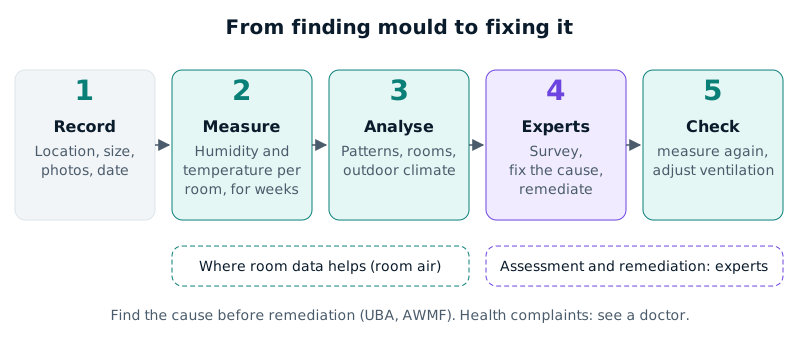 Figure 4: From finding mould to fixing it: room data complements the survey, it does not replace it. Own illustration based on UBA [4][8] and AWMF [6].
Limits and risks
- Data narrows down causes; it does not establish them. A thermal bridge, leak or rising damp is assessed on site by a qualified surveyor (in the UK often in a damp survey), if needed with moisture measurement in the fabric, thermal imaging and laboratory analysis. The UBA guide recommends a suitably qualified professional for the assessment [8].
- Room air sensors do not see the wall. Surface temperature has to be measured separately, and damage behind furniture, inside walls or under floor coverings may not show in room air at all.
- Remediation is a job for specialists. According to the UBA, small, superficial growth under about 0.5 m² can be removed yourself with protective measures; larger growth should always be remediated by a competent company [12]. People with mould allergy, chronic respiratory disease or a weakened immune system should not remove mould themselves [8][12].
- Measuring mould in the air is rarely useful. The AWMF guideline considers indoor mould measurements for medical reasons useful only rarely; where growth is visible, quantitative measurement can usually be omitted [6].
- Health belongs with a doctor. For symptoms, a doctor is the right contact; Nebatic makes no diagnoses. Environmental medicine advice centres and public health offices can also advise [8][11].
- Check after the work. A follow-up measurement over a few weeks shows whether the cause has really been removed, especially after insulation or window replacement, after which ventilation has to be adjusted [13].
Frequently asked questions
What causes mould in a flat?
Mould needs a damp surface. Usual causes are condensation on cold surfaces, thermal bridges, too little ventilation or heating, leaks, rising damp and construction moisture that has not dried out, often in combination [11][20]. Weeks of humidity and temperature data per room, plus the surface temperature at the affected spot, narrow down which dominates; a surveyor confirms building causes. UBA and AWMF stress finding the cause before remediation [6][12].
What humidity causes mould?
Humidity at the surface matters most: mould can grow from about 70 to 80% relative humidity at a surface if it lasts for some time [4]. For room air the UBA recommends 40 to 60% [9], which is also a good guide to ideal indoor humidity; at a strong thermal bridge even 50 to 60% can be too much.
What is the difference between condensation and rising damp?
Condensation damp forms when moisture generated indoors condenses onto colder parts of the building; it is the most common form. Rising damp is moisture from the ground rising through the building, mostly in older properties, and is often misdiagnosed [20]. In data, condensation shows daily peaks linked to use; rising damp shows permanently raised humidity near the ground with little daily rhythm.
Why does mould grow in corners and behind wardrobes?
External wall corners are geometric thermal bridges and colder than the rest of the wall, so surface humidity rises there first; in the German inspection study they were a separate risk factor for damp damage [3]. Behind furniture little warm air circulates; the UBA recommends a gap of about 10 cm [8][9].
Can a thermal bridge cause mould even with good ventilation?
Yes. If a spot is clearly colder than the German minimum requirement of DIN 4108-2 (temperature factor fRsi ≥ 0.70), surface humidity can become critical even at normal room humidity [15], as the worked example shows. A surveyor determines whether there is a thermal bridge.
Who is responsible for mould, the landlord or the tenant?
That depends on the cause, the individual case and the country. In Germany the UBA refers to tenants’ and landlords’ associations [8][13]; in England, Awaab’s Law sets timescales for social landlords on damp and mould hazards that present a significant risk of harm [21]. Data can provide a factual basis for the discussion but does not replace legal advice (general information, not legal advice, status: October 2026).
When do I need a damp survey?
With larger or recurring mould, when building causes such as thermal bridges, leaks or rising damp are suspected, when there is a dispute about the cause, and before major remediation. The UBA advises calling in experts when things are unclear and always having larger growth remediated by a competent company [12].
Sources
- Eurostat (2025): Share of total population living in a dwelling with a leaking roof, damp walls, floors or foundation, or rot in window frames of floor (EU-SILC, dataset tessi292), values for Germany. https://ec.europa.eu/eurostat/api/dissemination/statistics/1.0/data/tessi292?geo=DE&geo=EU27_2020&lang=EN
- Eurostat (2024): Housing in Europe – 2024 edition. https://ec.europa.eu/eurostat/de/web/interactive-publications/housing-2024
- Brasche, S.; Bischof, W. (2005): Vorkommen, Ursachen und gesundheitliche Aspekte von Feuchteschäden in Wohnungen – Gesonderte Auswertung für Nordrhein-Westfalen [Occurrence, causes and health aspects of damp damage in homes – separate analysis for North Rhine-Westphalia]. Jena University Hospital (referring to the nationwide study, Bundesgesundheitsblatt 8/2003). https://www.verbraucherzentrale.nrw/sites/default/files/migration_files/media5975A.pdf
- Umweltbundesamt (2017, status April 2024): Zur Vorbeugung, Erfassung und Sanierung von Schimmelbefall in Gebäuden – Leitfaden [Guideline on preventing, assessing and remediating mould in buildings]. https://www.umweltbundesamt.de/sites/default/files/medien/479/publikationen/240513_uba_fb_schimmelleitfaden.pdf
- Umweltbundesamt (2025): Aktueller UBA-Schimmelleitfaden [Current UBA mould guideline]. https://www.umweltbundesamt.de/themen/gesundheit/umwelteinfluesse-auf-den-menschen/schimmel/aktueller-uba-schimmelleitfaden
- AWMF / Gesellschaft für Hygiene, Umweltmedizin und Präventivmedizin (2023): S2k guideline Medizinisch klinische Diagnostik bei Schimmelpilzexposition in Innenräumen [Medical clinical diagnostics for indoor mould exposure], register no. 161/001, 2023 update (short version, published 03/2024). https://register.awmf.org/assets/guidelines/161-001k_S2k_Medizinisch-klinische-Diagnostik-bei-Schimmelpilzexposition-in-Innenraeumen_2024-03.pdf
- World Health Organization (2009): WHO guidelines for indoor air quality: dampness and mould. https://www.who.int/publications/i/item/9789289041683
- Umweltbundesamt (2014): Ratgeber – Schimmel im Haus [Guide: mould in the home]. https://www.umweltbundesamt.de/system/files/medien/378/publikationen/ratgeber_schimmel_im_haus_0.pdf
- Umweltbundesamt (2024): Wie lüfte ich richtig? – Tipps und Tricks zur Schimmelvermeidung [How to ventilate properly: tips for avoiding mould]. https://www.umweltbundesamt.de/themen/gesundheit/umwelteinfluesse-auf-den-menschen/schimmel/wie-luefte-ich-richtig-tipps-tricks-zur
- Umweltbundesamt (2013): Richtig Heizen, Schimmelbildung vermeiden [Heating properly, avoiding mould]. https://www.umweltbundesamt.de/themen/gesundheit/umwelteinfluesse-auf-den-menschen/schimmel/richtig-heizen-schimmelbildung-vermeiden
- Umweltbundesamt: Schimmel [Mould] (topic page). https://www.umweltbundesamt.de/themen/gesundheit/umwelteinfluesse-auf-den-menschen/schimmel
- Umweltbundesamt: Was tun bei Schimmel in meiner Wohnung? [What to do about mould in my flat?] https://www.umweltbundesamt.de/service/uba-fragen/was-tun-bei-schimmel-in-meiner-wohnung
- Umweltbundesamt (2022): Häufige Fragen bei Schimmelbefall [Frequently asked questions on mould]. https://www.umweltbundesamt.de/themen/gesundheit/umwelteinfluesse-auf-den-menschen/schimmel/haeufige-fragen-bei-schimmelbefall
- Bavarian State Ministry of Economic Affairs, Media, Energy and Technology; Supreme Building Authority (2014): Merkblatt 08 – Hinweise zum Energiesparen: Feuchte Wände und Schimmelbildung [Leaflet 08: damp walls and mould]. https://www.stmwi.bayern.de/fileadmin/user_upload/stmwi/Energie/Energiewende/Energieeffizienz/08_Hinweise_Energiesparen_Feuchte_Waende_und_Schimmelbildung_gesichert.pdf
- DIN 4108-2:2013-02: Wärmeschutz und Energie-Einsparung in Gebäuden – Teil 2: Mindestanforderungen an den Wärmeschutz [Thermal protection and energy economy in buildings – Part 2: minimum requirements for thermal insulation] (paid standard). Criterion fRsi ≥ 0.70 and boundary conditions explained in: Oberacker, R. (2002): EnEV praktisch umgesetzt: Temperaturfaktor anstelle Isothermen? GLASWELT 3/2002. https://www.glaswelt.de/sites/default/files/ulmer/de-gw/document/file_195787.pdf
- Bezirksamt Steglitz-Zehlendorf von Berlin, Environment and Nature Conservation Office (2013): Beispielhafte Thermographieaufnahmen [Example thermal images]. https://www.berlin.de/ba-steglitz-zehlendorf/politik-und-verwaltung/beauftragte/klimaschutz/beispielhafte_thermographieaufnahmen.pdf
- Bürgerliches Gesetzbuch (BGB, German Civil Code), § 535 Content and main obligations of the lease. https://www.gesetze-im-internet.de/bgb/__535.html
- Bürgerliches Gesetzbuch (BGB, German Civil Code), § 536 Rent reduction for material and legal defects. https://www.gesetze-im-internet.de/bgb/__536.html
- Regulation (EU) 2016/679 (General Data Protection Regulation). https://eur-lex.europa.eu/legal-content/EN/TXT/?uri=CELEX:32016R0679
- Ministry of Housing, Communities and Local Government; Department of Health and Social Care; UK Health Security Agency (2023, updated 2026): Understanding and addressing the health risks of damp and mould in the home. https://www.gov.uk/government/publications/damp-and-mould-understanding-and-addressing-the-health-risks-for-rented-housing-providers/understanding-and-addressing-the-health-risks-of-damp-and-mould-in-the-home—2
- Ministry of Housing, Communities and Local Government (2025): Awaab’s Law: guidance for social landlords – timeframes for repairs in the social rented sector. https://www.gov.uk/government/publications/awaabs-law-guidance-for-social-landlords/awaabs-law-guidance-for-social-landlords-timeframes-for-repairs-in-the-social-rented-sector