This article draws on US, UK and German guidance. General information, not legal advice (status: November 2026).
In short
- Night setback means lowering the heating set point when a building is unoccupied: at night, at weekends and on holidays. An office used 55 hours a week stands empty for about 113 of the 168 hours in a week (worked example below).
- A building that is allowed to cool loses heat more slowly. The common belief that reheating in the morning cancels the saving is a misconception for most systems [1].
- US federal guidance for building operators sets a target: energy use in unoccupied periods should be at least 50% and up to 80% lower than in occupied periods [2].
- Setback needs care with heat pumps and slow systems such as underfloor heating, where fast recovery can cost more than it saves [1][2].
- Room temperature data at night and at weekends shows whether setback actually happens and whether rooms are warm again when people arrive.
The symptom: a building heated by the calendar, not by its use
Most commercial buildings run on a heating schedule set at commissioning. Tenants change, working hours change, cleaning moves to the evening, and the schedule stays as it was. Facilities teams then find the same patterns again and again: setback starting at 10 pm although the office empties at 6 pm, weekends running on the weekday programme, public holidays never entered, and “temporary” overrides that were set during a cold snap and never removed.
The PNNL re-tuning guides for building automation call schedule overrides “often the number 1 challenge” to long-term scheduling, and note that they usually point to deeper problems with schedules, optimal start or setback settings [2].
Why setback saves energy
A building loses heat through its walls, windows, roof and ventilation, and the rate depends on the difference between indoor and outdoor temperature. Lower the indoor temperature and the building loses less heat for as long as it stays lower. Once a building has cooled below its normal temperature, it loses energy to its surroundings more slowly, so the heating system does not have to “work harder” to recover than it saved [1].
The US Department of Energy estimates that turning a thermostat back by 7–10 °F (about 4–6 K) for 8 hours a day can save up to 10% a year on heating and cooling, with larger savings in milder climates [1]. That figure comes from homes; commercial buildings have longer unoccupied periods, but also ventilation, larger thermal mass and more complex controls.
Worked example: how long an office stands empty
Worked example (own calculation, assumptions stated): an office is occupied Monday to Friday from 7 am to 6 pm.
| Hours per week | Share | |
|---|---|---|
| Occupied (Mon–Fri, 7 am–6 pm) | 55 | 33% |
| Weeknights | 65 | 39% |
| Weekend | 48 | 28% |
| Total | 168 | 100% |
Table 1: Occupied and unoccupied hours of an office with 55 occupied hours. Own calculation.
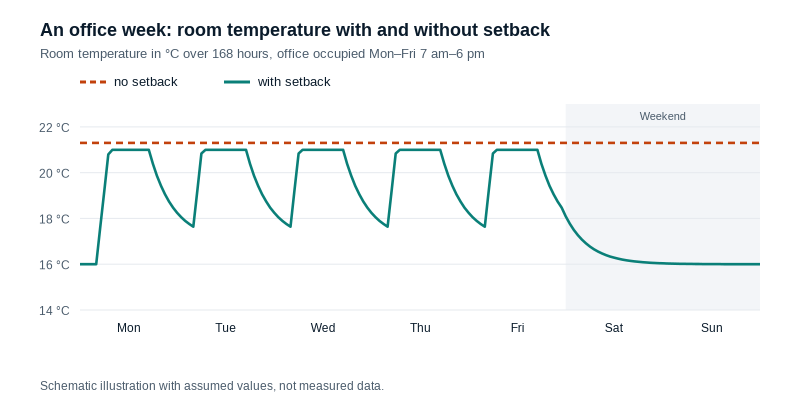
Figure 1: Weekly room temperature profile with and without setback. Schematic illustration, not measured data.
Two thirds of the week, the building is heated for nobody unless setback works. Holidays add to this: the PNNL guide estimates that scheduling ten public holidays as unoccupied saves about 1% of annual energy where it is not done yet [2].
Setback temperatures and optimal start
| Setting | Typical guidance | Source |
|---|---|---|
| Occupied heating set point | 68–76 °F (20–24 °C) range for occupied periods | [2] |
| Unoccupied heating setback | 55–62 °F (13–17 °C); 62 °F (17 °C) for high-mass or low-capacity buildings | [2] |
| Optimal start | Maximum pre-start of 2 hours | [2] |
| Workplace minimum (UK) | At least 16 °C (13 °C for rigorous physical work) while people work | [3] |
| Workplace minimum (Germany) | At least 20 °C for light seated work | [4] |
Table 2: Setback and occupancy temperatures. Status November 2026.
Optimal start (also called optimised start) lets the controller calculate, from outdoor and indoor temperature, how late heating can start and still reach the occupied set point on time. It replaces a fixed early start “just in case” and is one of the measures that the PNNL guide models at about 5% savings on its own [2].
When setback backfires
- Heat pumps. Heat pumps are most efficient at low flow temperatures. A deep setback followed by fast recovery forces high flow temperatures or electric back-up heaters, which can cancel the saving [1]. Shallow setbacks and longer unoccupied periods such as weekends work better.
- Slow systems. Underfloor heating and heavy concrete buildings can take several hours to respond [1]. A deep setback means rooms are still cold at 9 am, which leads to complaints and overrides.
- Damp-prone buildings. In poorly insulated buildings, cold surfaces during long setbacks can raise the risk of condensation and mould. Humidity in critical rooms is worth watching.
- Rooms that defeat the schedule. Radiator valves on maximum, portable heaters and meeting rooms kept warm “in case” keep parts of the building at daytime temperature all night.
Germany: what the law requires
In Germany, § 61 of the Building Modernisation Act (GModG, formerly the Building Energy Act) requires central heating systems to have automatic devices that reduce and switch off the heat supply depending on outdoor temperature or another suitable variable and on time [5]. The law requires the equipment, not a particular schedule; setting it to match real use is the operator’s job. This section explains the German rule; other countries have their own requirements.
How to get setback right
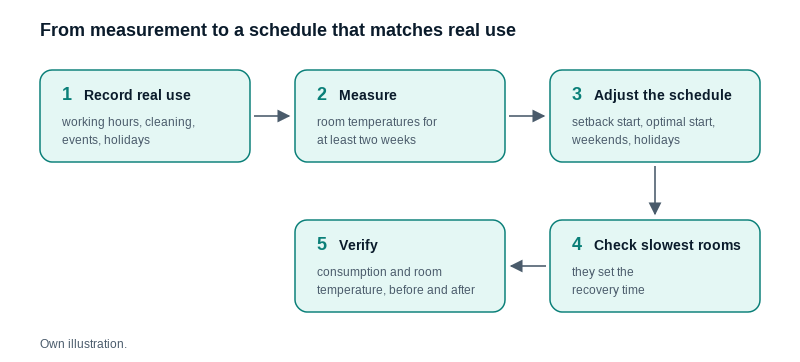
Figure 2: From measurement to a schedule that matches real use. Own illustration.
- Record real use: working hours, cleaning, evening events, holidays.
- Measure: room temperatures for at least two weeks, including nights and weekends.
- Adjust the schedule with the heating contractor or BMS engineer: setback start, optimal start, weekend and holiday programmes.
- Check the slowest rooms: they determine the recovery time.
- Verify: compare weather-normalised consumption and room temperatures before and after.
How Nebatic helps
Nebatic measures temperature, humidity and CO₂ continuously, room by room. The histories show whether rooms really cool down at night and at weekends, which zones defeat the schedule and whether rooms reach their set point when people arrive. CO₂ shows when rooms are actually occupied, which helps match schedules to real use. See finding the causes of high heating costs and heating control by occupancy.
Nebatic does not change heating settings. Schedules and controls are adjusted by the heating contractor or the building’s technical team.
Risks and limits
- No savings promise: the published percentages come mostly from homes or models [1][2]. Only your own before-and-after data shows what your building saves.
- Comfort and safety: occupied set points must meet workplace rules during working hours [3][4]. Frost protection, hot water and ventilation have their own requirements.
- Specialist work: changes to controls belong with qualified contractors.
For further measures in day-to-day operation, see how to reduce energy costs in commercial buildings.
Night setback: quick answers
Does night setback save energy in an office?
In most buildings with radiators, yes. A cooled building loses heat more slowly, and the morning recovery does not use more energy than the setback saved [1]. Offices stand empty for around two thirds of the week.
What temperature should a commercial building be set back to?
US re-tuning guidance suggests heating setbacks of 55–62 °F (13–17 °C), with the higher end for heavy or low-capacity buildings [2]. The right value depends on construction, heating system and recovery time.
Should I use night setback with a heat pump?
Only a shallow one. Deep setbacks force high flow temperatures or electric back-up heat during recovery, which can cancel the saving [1]. Weekend setback is usually more worthwhile.
What is optimal start?
A control function that calculates how late heating can start and still reach the occupied set point on time, instead of a fixed early start [2].
How do I know if setback is working?
Look at room temperatures at night and at weekends. If they stay at daytime level, setback is not happening, whatever the schedule says.
Sources
- U.S. Department of Energy, Energy Saver: Thermostats. https://www.energy.gov/es/energysaver/thermostats
- Underhill, Taasevigen / Pacific Northwest National Laboratory (2019): Army Re-tuning Implementation Guides, PNNL-29078. https://www.pnnl.gov/main/publications/external/technical_reports/PNNL-29078.pdf
- Health and Safety Executive (HSE): Temperature in the workplace – what the law says. https://hse.gov.uk/temperature/employer/the-law.htm
- Haufe: ASR A3.5 – minimum room temperatures at work (German). https://www.haufe.de/arbeitsschutz/gesundheit-umwelt/asr-a35-ab-wann-ist-die-raumtemperatur-zu-kalt_94_530038.html
- Building Modernisation Act (GModG), § 61 (German). https://www.gesetze-im-internet.de/geg/__61.html