
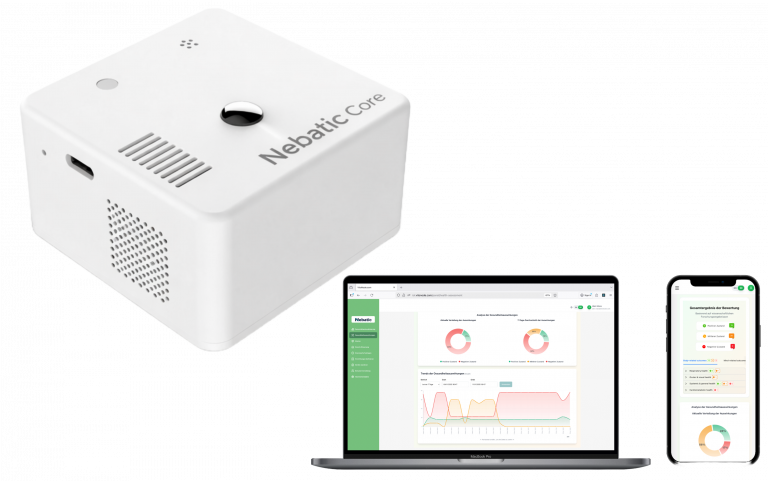
Whether at home, in offices, educational institutions, care facilities, hotels, restaurants, or other buildings – Nebatic is highly versatile and can be used across various building types and their diverse indoor environments.
System-wide
All-in-One: Integrated Software and Hardware
The Nebatic system forms a functional unit consisting of proprietary hardware and a tightly aligned software platform. The hardware component integrates all required sensors and electronic components on a custom-developed printed circuit board to precisely capture relevant indoor environmental variables and locally organize data flows.
This physical layer directly interfaces with the platform, which is provided as a multi-tenant SaaS solution accessible via both a web application and mobile apps for Android and iOS. Due to the factory-level alignment between firmware and cloud backend, complex interface configurations are eliminated. After power supply and initial Wi-Fi setup, the device automatically transmits formatted data to the central database without requiring additional infrastructure. The software accesses this data stream directly and handles further processing, visualization, and control of connected processes.
High flexibility through integration of existing systems and data sources
The Nebatic platform is designed as an open system that processes not only proprietary sensor data but also information from external sources. Existing infrastructure components such as energy meters, building management systems, or third-party sensors can be directly integrated into the data architecture.
Technical integration is carried out via defined interfaces, for example APIs for continuous data streams or import functions for structured file formats such as CSV. Once these external data sources are captured within the system, they are normalized and made available for the same analysis and visualization processes as data from proprietary devices. This enables centralized analysis and correlation of heterogeneous building data, allowing existing systems to be incorporated into the platform’s evaluation logic without hardware replacement.
Scalable from single rooms to building portfolios
The system supports scalable structuring ranging from monitoring individual rooms to managing complex building portfolios. For this purpose, a hierarchical structure of facilities, floors, and rooms is established within the platform, serving as the logical basis for data assignment, filtering, and visualization.
In addition, user management enables differentiated assignment of access rights through a role-based system. While administrators are granted full management privileges, standard users can be assigned specific permissions. These access levels can be configured granularly, allowing users access to the entire system or only to selected devices and functions, such as alarm management or device control.
Continuous development through OTA updates
The long-term technical currency of the Nebatic system is ensured through the implementation of over-the-air (OTA) updates. Since the devices are equipped with integrated Wi-Fi connectivity, firmware updates can be transmitted wirelessly and securely directly to the microcontroller.
This enables the deployment of functional enhancements, optimized processing algorithms, or security updates during ongoing operation, without physical intervention or device disassembly. Through this remote maintenance capability, installed hardware remains synchronized with ongoing developments and new features of the central software platform, significantly reducing on-site maintenance effort.
Measurement
High-precision sensor technology and data acquisition
Data acquisition is performed using specialized sensor components on the circuit board, measuring parameters such as carbon dioxide (CO₂), temperature, relative humidity, volatile organic compounds (VOCs), particulate matter across different particle sizes (PM1.0 to PM10), as well as light intensity and noise levels.
The sensors are controlled by an integrated microcontroller, which manages the readout process at configurable time intervals and performs local plausibility checks at the firmware level to ensure measurement validity prior to transmission. The validated data are then structured in JSON format to ensure standardized processing within the software platform.
Wireless and real-time data transmission and monitoring
Captured environmental parameters are transmitted wirelessly via the integrated Wi-Fi module (802.11 b/g/n) directly to the central database, without requiring additional gateway infrastructure. The microcontroller controls data acquisition at configurable intervals—such as every 10 or 20 minutes—and formats the measurements into structured JSON packets for transmission.
Prior to transmission, data undergo local plausibility checks at the firmware level to ensure data integrity. Within the software platform, incoming data records are processed immediately and visualized as live data, enabling continuous monitoring of current room conditions. In addition to real-time views, data are stored historically, allowing trends over defined periods—such as the last 24 hours or 7 days—to be visualized and analyzed graphically.
Flexible hardware options for different building types
To address the diverse requirements of modern building structures, the hardware is available in two specialized configurations. The base variant focuses on high-precision measurement of essential air quality parameters (CO₂, temperature, humidity, VOCs, particulate matter). The extended version additionally integrates sensors for light intensity and acoustic levels, providing a holistic representation of the indoor environment.
This differentiation enables economically and functionally efficient equipment strategies: while productivity-critical areas such as open-plan offices, meeting rooms, or classrooms require comprehensive analysis including visual and acoustic stress factors, transit zones, storage areas, or passive spaces can be monitored cost-effectively with a focus on climatic conditions. Regardless of the selected variant, both device types integrate seamlessly into the central platform, enabling flexible mixed deployment within a building without compromising data consistency or management uniformity.
Easy installation without structural modifications
Hardware installation is designed to require no structural building modifications. A separate, custom mounting solution is used for physical placement, suitable for both freestanding installation on flat surfaces and wall mounting.
Depending on surface conditions and requirements, the mount can be secured using double-sided mounting tape or mechanical fastening with screws and anchors, ensuring stable positioning within the optimal measurement zone. Operation does not require permanently installed wiring, as power is supplied via a USB-C power adapter. Logical system integration is completed entirely via software after physical placement, using serial number registration and Wi-Fi configuration.
Analysis
Holistic, algorithmic, and context-based analysis of health effects
Health impact analysis evaluates the influence of measured environmental variables on human well-being using an integrated computational model. Evaluation is conducted across three core categories: physical health indicators, psychological health indicators, and performance and productivity indicators.
Based on current sensor data, the system determines specific states for each category. The analysis extends to individual symptoms and subcategories, enabling correlations between room variables and concrete effects such as headaches, fatigue, or systemic health conditions. Results are visualized both as real-time snapshots and as historical trends, allowing long-term developments and averages—such as comparisons with the previous seven days—to be assessed.
Multifactor energy optimization for maximum efficiency
Energy optimization is based on continuous acquisition and analysis of energy-relevant environmental variables such as temperature and light intensity. Measured values are continuously compared against defined thresholds, which can be flexibly adapted to seasonal requirements—for example differentiating between cold and warm seasons.
Historical visualization of these data makes deviations from energetically optimal ranges and inefficient patterns—such as unnecessary heating or lighting—transparent. Visualization employs a traffic-light system that marks values outside optimal ranges as warning or critical zones. This analytical evaluation serves as the decision basis for manual adjustments or the definition of automated scenarios, enabling efficient, demand-oriented control of connected devices such as thermostats or lighting systems.
Customizable and pattern-based alerts
Alarm management is technically based on monitoring defined threshold values that divide the measurement range of each variable into zones such as optimum and warning. These thresholds are dynamic rather than static and can be adjusted through a scheduling function to specific time windows and recurring patterns such as daily or weekly cycles, accommodating different operational states.
An alert is triggered when a measured value crosses a defined transition between these zones. Notifications can be configured to be delivered via email or as push notifications within the app. To minimize disturbances during non-operational periods, the system incorporates an exclusion logic that suppresses notifications during specific time intervals or days of the week, while events continue to be logged in a filtered inbox for documentation and traceability.
AI-powered premium reporting
The customized analytical report extends the existing assessment results by adding a structured interpretation, contextual classification, and strategic derivation of relevant developments beyond the pure evaluation layer.
Based on aggregated time series, usage patterns, and correlative relationships, the AI systematically processes large volumes of data and transforms them into clear, actionable decision foundations. In doing so, it not only identifies deviations, but also reveals trends, interactions between environmental parameters, and potential optimization scenarios. The analysis accounts for spatial differences, functional usage contexts, and defined priorities, enabling differentiated evaluation of individual zones and time periods. This creates a robust basis for both operational adjustments and long-term strategic development.
Control
High interoperability and protocol support
The system architecture acts as a central control unit that enables direct integration of external smart devices into the existing building infrastructure. Through the platform-side pairing functionality, compatible third-party devices within the environment are identified and integrated into the system by selecting the corresponding manufacturer or brand.
This interoperability enables centralized management of various actuators—such as smart radiator thermostats or intelligent power outlets—via a unified user interface. As a result, existing ventilation, heating, or lighting systems can be digitally networked and controlled without requiring a complete replacement of hardware components, provided that the devices offer appropriate communication interfaces.
Scenario-based or user-initiated control
Control of paired devices can be performed either automatically through definable scenarios or via direct manual intervention. In scenario-based control, specific trigger conditions—such as exceeding or falling below sensor threshold values—are defined and logically linked to initiate actions on actuators such as thermostats or lighting switches.
These automation rules can be configured temporally using start and end points as well as recurring patterns (e.g. daily or weekly) and are managed through a calendar-based interface. In addition, the immediate control function enables direct access to actuators, allowing commands such as switching devices on or off or adjusting performance levels to be executed manually without delay. To prevent conflicts between automated control and manual intervention, active scenarios can be temporarily deactivated, ensuring that manual settings are not overridden by cyclical automation routines.